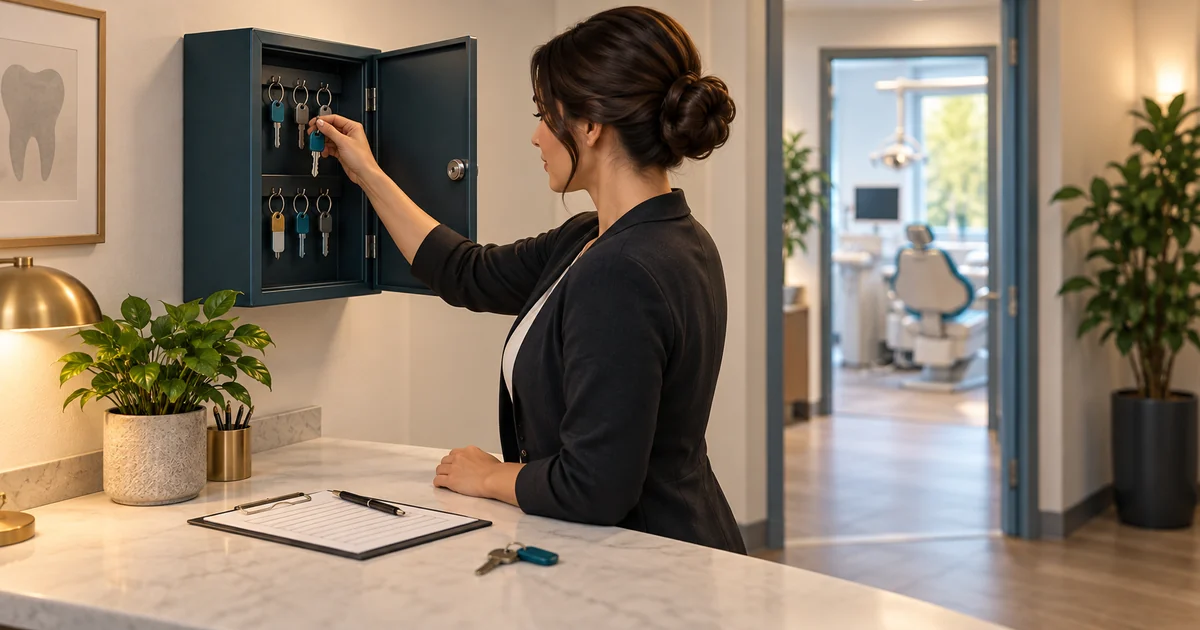
A dental office key control policy should identify every physical key and access badge, who holds it, what it opens, and how the practice will recover or disable it. Begin with an inventory of existing credentials, then create an issue-and-return register. An unrecorded spare can leave access open after an employee's listed key is returned.
Assign one custodian and a backup. Give each holder only the access their approved duties require, and make lost-key reporting immediate. Entry controls must also preserve safe exit from the building.
Define which physical access the policy covers
Include exterior doors, staff entrances, restricted rooms, records cabinets, equipment areas, storage, and any other location the practice controls. List mechanical keys, master keys, badges, fobs, and shared door codes where used. Identify locks or credentials controlled by the landlord or a building security provider.
For a HIPAA-covered practice, physical access also belongs in its protection of electronic patient information. HHS includes facility access controls among the Security Rule's physical safeguards. A key register is a practical office control; this article's format is not a federally prescribed form. HHS explanation of physical safeguards
Connect the policy to the broader dental office HIPAA review. A locked entrance alone does not establish that screens, paper records, devices, or other information are protected.
Keep physical custody distinguishable from digital account permission. A returned front-door key says nothing about a former employee's phone-system administrator role; use the phone-system access audit for that separate inventory.
Start with doors and duties, then assign holders
Walk the premises with the person responsible for facilities. Identify each controlled opening, the corresponding lock or reader, who manages it, and which credential types operate it. Keep this detailed access map restricted to authorized staff.
Next, ask what access each job actually needs. A staff member opening the office may need exterior entry without access to every locked cabinet. A cleaning contractor may need a defined route and time window, subject to the arrangement the practice has approved. Seniority is not a reason to issue a master key.
Record restrictions the hardware can enforce and those that depend on procedure. A mechanical key generally cannot be disabled remotely like an electronic credential. Do not describe a limited permission on paper as though the lock itself prevents other access.
If existing locks make the intended separation impossible, document the gap and have the owner, landlord, and qualified access professional evaluate options. The policy should accurately describe the current arrangement while the approved improvement is pending.
Make the register useful at return time
Give each credential an internal identifier. Avoid attaching the practice address or a detailed room description to the key itself. Keep the connection between identifier and location in the controlled register.
| Register field | What it establishes |
|---|---|
| Credential identifier and type | The particular key, badge, or fob being tracked |
| Authorized access | Relevant doors or areas, with any enforceable time limits |
| Holder and organization | The employee, owner, or contractor responsible |
| Business purpose and approver | Why access was granted and who authorized it |
| Issue date and acknowledgment | When custody began and instructions were received |
| Review or return trigger | Role change, assignment end, departure, or stated expiration |
| Return or disablement evidence | Item received or access removed, date, and verifier |
| Exception | Missing item, temporary arrangement, or unresolved action |
Keep the register free of unnecessary patient or personnel information. Store door-code values and sensitive access details only through the practice's approved restricted process.
At issue, verify the recipient and authorization, record the exact item, and explain permitted use. The acknowledgment should address custody, reporting, return, and the office's prohibition on unauthorized copying or lending. A signature documents the instruction; it cannot prove that an unknown duplicate does not exist.
Control spares and temporary access
Count spares as issued property held by the custodian, not as an untracked category. Store them in the approved locked location. Record each temporary checkout, its purpose, recipient, expected return, and actual return.
A spare left in a desk drawer because “everyone knows where it is” defeats the custody record. If the office needs emergency access, establish a controlled arrangement that the designated backup can use. Confirm the landlord's and emergency responders' requirements with the responsible facilities professional.
For contractors, verify the authorized organization and individual before handing over access. Define the permitted work area, hours, supervision where required, and end condition. Recover temporary credentials when the work finishes or have the authorized administrator disable them.
Inspect recurring arrangements periodically. A contractor's employee may change while the company name stays the same. Ask who currently holds the credential and reconcile that answer with the actual return or reissue record.
Give a missing key an immediate response path
Tell holders whom to contact during and outside office hours. Reporting should not wait until the person finishes searching or the next manager shift begins.
The response owner should record the credential identifier, last known possession, affected areas, circumstances, and any indication of unauthorized use. Preserve available facts and access records through the approved process. Staff should not decide by themselves that there was no exposure.
For a lost badge or fob, ask the authorized administrator to disable the specific credential and verify the result. For a mechanical key, assess the affected locks with the owner and facilities or security professional. A replacement key gives the employee another copy; it does not remove access held by whoever finds the original.
Depending on the facts, the approved response may include rekeying, lock replacement, temporary supervision, or landlord coordination. The privacy or security owner determines whether the event also needs incident assessment. Record the containment action and what remains unresolved, without declaring that every lost key is automatically a reportable breach.
Keep entry restrictions compatible with safe exit
Review proposed locks and badge readers with a qualified installer and the responsible fire or building authority. Under OSHA's general-industry exit rule, employees must be able to open exit-route doors from inside without needing a key, tool, or special knowledge. A failed device or alarm must not restrict emergency use of the exit. Current federal exit-route requirements, 29 CFR 1910.36(d)
Do not add a second interior lock or improvise a badge requirement for leaving because entry control feels insufficient. Check the applicable local requirements and have the authorized professional verify normal operation and relevant failure conditions. Keep evacuation paths clear during any lock work.
Reconcile access after a change
At a departure or role change, compare the holder's full register entry with the items returned and permissions still needed. Record physical return separately from electronic disablement. Review shared codes the person knew and any contractor or landlord access connected to the change.
Use the employee offboarding checklist to coordinate the authorized cutoff and property receipt. A missing key remains an access exception with a response owner even when the other departure tasks are complete.
Choose a recurring review interval appropriate to the office, plus reviews after staffing, vendor, location, and lock changes. Count controlled spares, verify named holders, inspect unresolved returns, and retire obsolete credentials through the approved process. The finished review should reconcile actual access with current duties, with evidence for every correction.