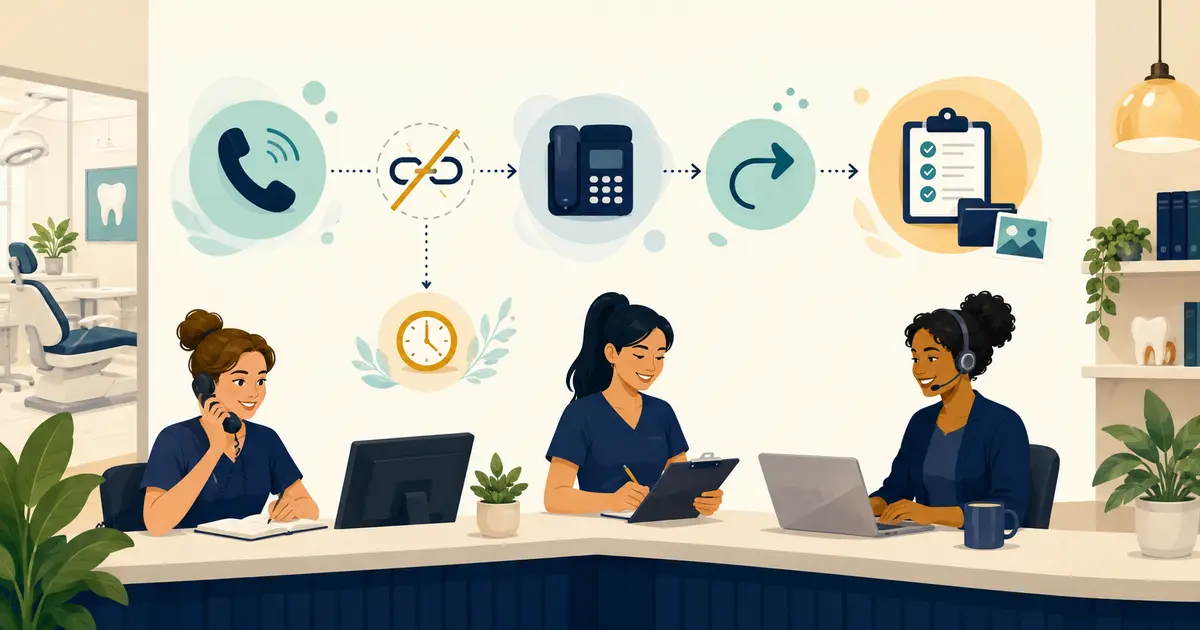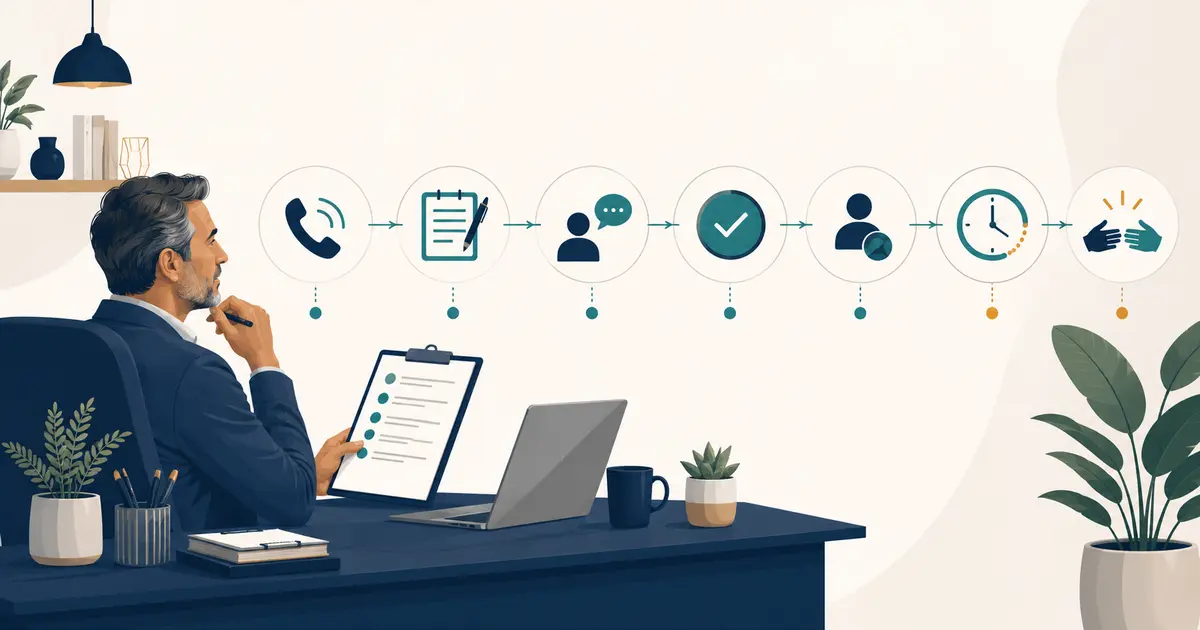
Dental front desk phone etiquette is a repeatable set of behaviors: answer with a clear greeting, listen before questioning, explain holds and transfers, protect privacy, state whether a request is pending or complete, assign the next action, document facts, and close with an accurate expectation. Professional etiquette is not a scripted “cheerful voice” alone; it is reliable communication that helps the caller and the next employee understand what happens next.
Use this checklist during onboarding, role-play, and team calibration. Adapt the examples to the practice's actual authority, systems, policies, and local requirements.
1. Prepare before the phone rings
- Sign in with your individual account.
- Open the approved phone, schedule, request queue, and office-knowledge tools.
- Check current hours, location changes, provider coverage, and known outages.
- Review who owns scheduling, billing, clinical, complaint, and manager handoffs today.
- Keep the reception area quiet enough for calls and protect the screen from public view.
- Do not use personal notes or messaging apps for patient requests.
If the information source conflicts with what you remember, use the current approved source or verify with the owner. Never guess because the line is ringing.
2. Answer with a complete greeting
“Thank you for calling Green Valley Dental. This is Jordan. How may I help you?”
The greeting should:
- identify the practice;
- identify the employee;
- invite the caller's reason;
- use a measured pace;
- avoid background conversation.
The ADA recommends a standard greeting that includes the practice and employee names and invites the caller to share why they called. See the ADA patient-intake phone guidance.
Do not answer only “Dental office” or “Please hold.” If several calls arrive, acknowledge the new caller and offer a choice under the office's queue rule.
3. Listen before completing a form
Let the caller finish the first thought. Then summarize:
“You are calling to ask about becoming a new patient and would prefer the North office. Is that right?”
Ask one question at a time. Useful early questions include:
- “Are you calling about a new request or an existing appointment?”
- “Which office are you trying to reach?”
- “What is the best number for the appropriate team member to return your call?”
Avoid interrogating the caller. Collect only what the next step requires. Do not ask for detailed clinical information merely to fill a field.
4. Use the caller's name naturally
After the caller provides a name, confirm the spelling when needed and use it once or twice naturally. Do not repeat the full name loudly in an open area.
If identity must be verified before discussing protected information, follow the practice's approved procedure. Knowing the patient's name is not always sufficient authorization to discuss an appointment, balance, treatment, or record with the caller.
If a family member or another person calls, do not reveal details simply because they know something about the patient. Gather the request and route it under the practice's privacy policy.
5. Ask before placing a caller on hold
“May I place you on a brief hold while I verify that information, or would you prefer a callback?”
If the caller agrees:
- state a realistic short estimate;
- use the phone's hold function rather than covering the handset;
- return within the office standard;
- give a useful update;
- offer a callback when the wait becomes uncertain.
Do not say “one second” when you do not know. Do not leave a caller on silent hold while starting a long administrative task.
The call queue guide provides the complete rule for simultaneous calls, callbacks, and overflow.
6. Explain transfers and confirm the destination
“The scheduling team can review that request. May I place you on a brief hold while I confirm someone is available?”
Before transferring:
- tell the caller which role or location will receive the call;
- explain why;
- confirm the destination is available when possible;
- share only the minimum handoff information;
- return to the caller if nobody answers.
Avoid “That's not my department.” Use “The billing team is the right group to review that account question.”
Do not transfer a clinical concern blindly to voicemail. Follow the approved clinical handoff process.
7. State the exact appointment status
Use language that matches the system.
Request only
“I recorded your appointment request. No time has been scheduled yet.”
Appointment saved
“Your appointment is saved for Tuesday, September 8 at 2:00 p.m. at the North office.”
Cancellation pending
“I sent your cancellation request for review. The appointment is still active until the scheduling team confirms the change.”
Appointment canceled
“The appointment on Tuesday at 2:00 p.m. is canceled in the schedule. No replacement time has been selected.”
Do not say “you're all set” when only a note or request was created. The cancellation and rescheduling scripts provide additional pending-versus-complete wording.
8. Keep insurance and price answers accurate
Separate general office information from an individual determination.
“Our office can explain the plans we participate with. Your individual eligibility, benefits, deductible, and expected responsibility still require verification.”
For a price inquiry:
“The cost depends on the service and clinical evaluation. I can explain any verified office pricing information we are authorized to share and send your question to the appropriate team member.”
Do not promise what an insurer will pay. Do not estimate treatment or diagnose what the caller needs from a brief phone description.
9. Route clinical and urgent statements safely
Front desk phone etiquette does not require clinical judgment. It requires an accurate handoff.
“I am not able to give clinical advice, but I can collect the best callback number and send your concern to the designated clinical team member.”
Follow the practice's approved emergency and after-hours instructions. If the caller describes a life-threatening emergency, use the exact practice wording directing them to 911 or emergency care. Do not decide that a caller is “fine,” tell them to wait, or recommend treatment.
Collect the minimum information required by the office process. State who owns the handoff and what response expectation is actually approved.
10. Respond to an upset caller without arguing
Use a calm sequence:
- let the caller explain;
- acknowledge the concern without admitting an unverified conclusion;
- summarize the facts;
- state what you can do;
- assign the handoff.
“I understand that you are concerned about the charge. I will document what you told me and send it to the manager who reviews account questions. I cannot change the balance on this call.”
Do not match the caller's volume, interrupt repeatedly, blame another employee, or promise a refund or policy exception. The angry-patient call guide provides a full listen-document-handoff framework.
11. Protect privacy in the reception area
- Lower your voice when discussing protected details.
- Move the conversation when reasonable.
- Avoid speakerphone where others can hear.
- Do not repeat the patient's concern across the room.
- Keep papers and screens out of public view.
- Confirm identity under office policy.
- Use only individual, approved system accounts.
- Do not leave detailed voicemail without the approved safeguard.
- Report a misdirected message or access concern promptly.
HHS explains that providers may have oral conversations when they use reasonable safeguards appropriate to their circumstances. Review the HHS guidance on confidential conversations with the practice's own policy.
12. Leave a limited voicemail
Before leaving a message, check the patient's communication preference and the practice's approved procedure.
“This is Green Valley Dental trying to reach Jordan. Please call us at 312-555-0148 during office hours. Thank you.”
Do not include treatment, a balance, insurance detail, a missed-appointment pattern, or a clinical concern unless the practice has determined that the content and safeguard are appropriate.
HHS permits appointment-related voicemail with reasonable safeguards and recommends limiting the amount disclosed. See the HHS appointment-message guidance.
If someone else answers, identify the practice only to the extent approved and request a return call. Do not disclose why you are calling.
13. Make callbacks real commitments
A callback entry needs:
- confirmed number;
- general reason;
- location;
- assigned owner;
- approved response window;
- current status;
- outcome.
“Taylor owns this request and will review it by [approved window]. No appointment or account change has been completed yet.”
Do not promise “right away” or “today” unless the office has assigned that standard and capacity. If the callback becomes overdue, update the caller and manager rather than silently extending the deadline.
14. Document facts immediately
Good notes describe the request and status:
- “Caller requests new-patient appointment; weekday afternoon preferred; no appointment scheduled.”
- “Patient asked whether plan is accepted; provided approved general statement; individual benefits not verified.”
- “Complaint about wait time routed to manager; no outcome promised.”
- “Clinical concern routed to designated clinical role; no advice provided.”
Avoid:
- “difficult patient”;
- “always complains”;
- “probably not urgent”;
- “seems confused”;
- copied details unrelated to the next action.
Use neutral language and complete the note before the request disappears behind the next call.
15. Close with one clear next step
Before ending, repeat:
- what was completed;
- what remains pending;
- who owns it;
- the approved expectation;
- the office's contact path.
“To confirm, your appointment request is recorded but no time is reserved. Taylor will review it by [approved window] and contact you at the number ending in 0148. Is there anything about that next step I should clarify?”
Then thank the caller:
“Thank you for calling Green Valley Dental.”
Avoid using “Have a perfect day” after an upsetting call. A simple, respectful close is enough.
16. Handle accessibility and relay calls professionally
Treat Telecommunications Relay Service calls like other calls. Listen to the operator's introduction, speak directly to the caller, allow the additional time, and follow the same identity and privacy process.
The ADA says practices should respond to relay calls in the same way as other calls and ensure automated phone systems support effective communication with auxiliary services. Review the ADA telecommunications accessibility guidance.
Do not hang up because the call sounds unusual or because an operator participates. Do not rush a caller who communicates differently.
17. Know what to do when the answer is unknown
Professional dental phone etiquette includes saying you need to verify.
“I want to make sure I give you accurate information. May I confirm that with the appropriate team member and call you back?”
Then create the callback before moving on. Do not invent an answer, rely on an old memory, or search an unapproved public source for patient-specific guidance.
Managers should review repeated unknown questions and update the office knowledge source, script, or policy.
Quick dental receptionist phone etiquette checklist
On every call:
- [ ] Identify the practice and yourself.
- [ ] Invite the caller's reason.
- [ ] Listen before asking a sequence of questions.
- [ ] Confirm the goal, location, and return number when needed.
- [ ] Ask before hold or transfer.
- [ ] Protect privacy in speech, systems, voicemail, and notes.
- [ ] Stay within scheduling, insurance, financial, and clinical authority.
- [ ] Say whether the request is pending or complete.
- [ ] Assign callbacks and handoffs to one visible owner.
- [ ] Give only an approved response expectation.
- [ ] Document neutral facts and current status.
- [ ] Close by repeating the next step.
At the end of the shift:
- [ ] Review held, transferred, overflow, voicemail, and callback work.
- [ ] Resolve duplicates.
- [ ] Escalate overdue or blocked requests.
- [ ] Update known office facts or script questions for the manager.
- [ ] Sign out and secure call notes.
Professional dental receptionist phone etiquette is visible in the handoff. The caller knows what happened, the next employee sees an accurate record, and the practice makes no promise that its systems, staff, or clinical team have not actually confirmed.