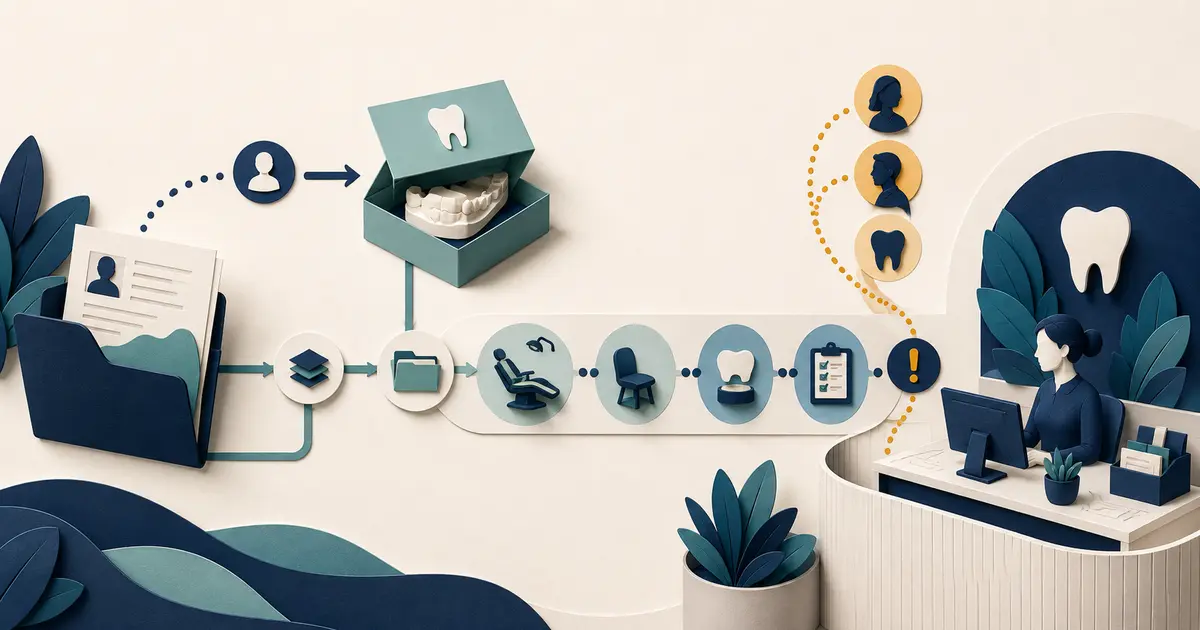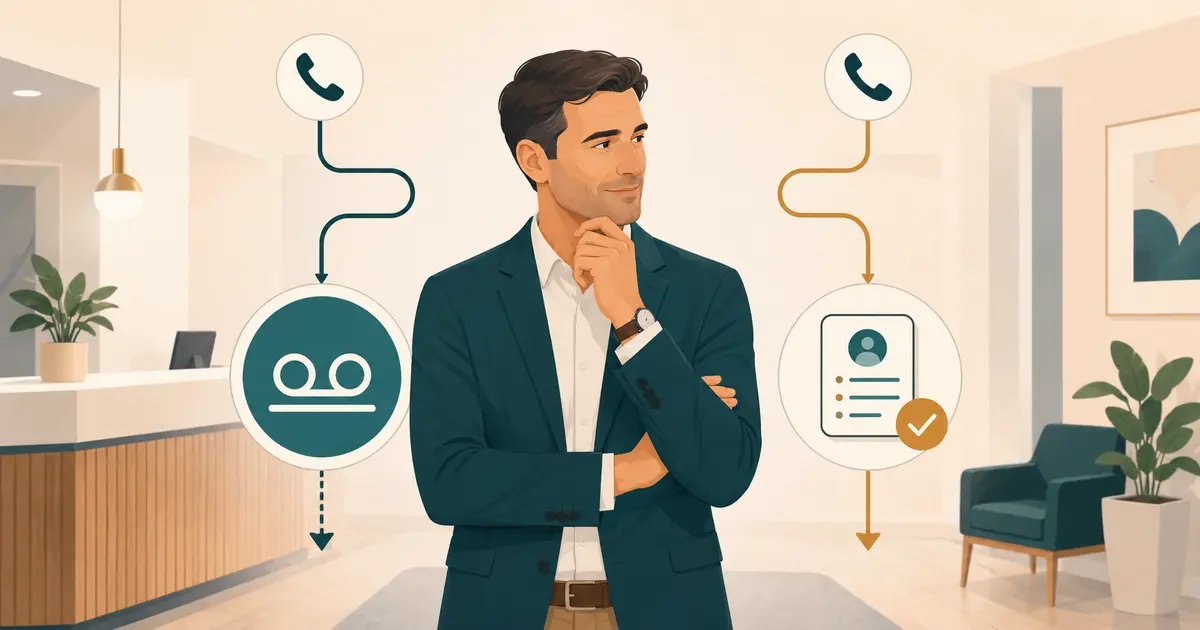
The practical choice between a dental answering service vs. voicemail is this: voicemail records what a caller decides to leave, while an answering service can guide the conversation and create a more structured request. Voicemail may be enough when missed calls are uncommon and staff return messages reliably. Additional answering coverage fits better when callers frequently need help stating their request, confirming basic office information, or reaching a defined next step.
Neither option removes the front desk's responsibility. The office still needs clear scripts, an owned queue, a callback process, and a separate practice-approved path for urgent concerns. The better option is the one that produces usable requests without creating more confusion for callers or staff.
Compare the operating model, not just the greeting
The two options solve different parts of the missed-call problem.
- Voicemail gives the caller an opportunity to record a message after the office does not answer.
- An answering service interacts with the caller within an approved scope, collects specific details, and sends a handoff to the office.
That distinction affects what the caller must do and what the front desk receives. A perfect voicemail greeting cannot make a caller leave a complete message. An answering service can ask follow-up questions, but it still needs accurate office information, clear boundaries, and a reliable destination for the request.
If you need a broader explanation of coverage models, start with how dental answering services work. This comparison focuses on the daily operating decision between interactive coverage and a message box.
Dental answering service vs. voicemail at a glance
| Decision factor | Voicemail | Answering service |
|---|---|---|
| Caller experience | Caller listens and leaves a message without interaction | Caller can respond to questions within the approved script |
| Request completeness | Depends on what the caller remembers to say | Can collect a defined set of fields in a consistent order |
| Basic office questions | Usually deferred to staff callback | May be answered only from approved, current office information |
| Appointment intent | Caller describes the request in their own message | Service can collect preferences without promising a booking |
| Staff review | Staff listen, interpret, and document the message | Staff may receive a structured summary or request |
| Control | Simple, familiar, and easy to limit | Requires scripts, permissions, vendor review, and testing |
| Failure mode | Empty, vague, long, or hard-to-hear message | Incomplete or incorrect handoff if the workflow is poorly configured |
| Cost | Often included with the phone service | Separate service cost and possible usage charges |
The table does not make one option universally better. It shows where the work happens. Voicemail puts more responsibility on the caller and the person returning the message. An answering service moves more of the collection step into the initial call, but the practice must design and supervise that step.
When voicemail can be the right fit
Voicemail can be a sound choice when the office has a small and predictable gap rather than a persistent coverage problem.
It may fit when:
- missed calls are infrequent;
- most callers already know exactly what message to leave;
- one person checks messages at defined times;
- the office returns calls consistently;
- basic office information is easy to find elsewhere;
- the practice wants the narrowest possible after-hours interaction;
- the existing phone system provides reliable voicemail and notifications;
- staff can listen and document messages without creating a backlog.
The important test is not whether voicemail exists. It is whether the full message-to-callback process works. A voicemail box that fills up, sends alerts to an unmonitored inbox, or receives messages without usable callback numbers is not a low-cost solution. It is an unowned queue.
Make voicemail operationally complete
A useful dental voicemail workflow should define:
- the greeting callers hear during each coverage window;
- the exact details callers are asked to leave;
- the approved instruction for life-threatening emergencies and the practice's separate after-hours resource;
- who checks the box during office hours, after lunch, and at opening;
- the backup owner when the primary person is absent;
- how the message becomes a visible front-desk task;
- when the task is considered complete;
- what happens when the recording is empty or unclear.
Keep the greeting short. Ask for a name, callback number, general reason for the call, and the information the office needs for the next step. Do not ask callers to leave detailed clinical information in an ordinary message.
When an answering service is a better fit
An answering service becomes more useful when the initial interaction needs structure. The service can ask for missing information, repeat a callback number, distinguish the intended location, and set an accurate expectation about front-desk follow-up.
It may fit when:
- callers often leave incomplete messages;
- the office has regular busy, no-answer, lunch, or after-hours gaps;
- new-patient inquiries are important and callers frequently ask basic questions;
- staff spend too much time replaying and interpreting recordings;
- more than one location or team may own the follow-up;
- the practice needs consistent request fields across coverage windows;
- owners want to test calls and review the resulting handoff;
- the office can maintain one approved source of hours, services, policies, and other basic facts.
An answering service should not become an unapproved extension of clinical or scheduling work. Unless the service has verified access and authority, it should capture appointment preferences rather than claim a time is booked, and it should hand clinical questions to the practice rather than diagnose or decide urgency.
For service-selection questions specific to closed-office coverage, review after-hours answering-service options and tradeoffs.
Compare the caller's effort
Voicemail asks the caller to organize the request without help. Some callers will leave a complete message. Others may hang up, speak too quickly, omit a number, or assume caller ID is enough.
Interactive coverage can reduce that effort by using a short sequence:
- identify the practice;
- ask what the caller needs;
- collect or confirm the callback number;
- ask only the approved follow-up questions;
- state what will happen next;
- create one request for the correct team.
Do not confuse more questions with a better experience. A long intake can frustrate a caller just as much as a long voicemail greeting. Collect the minimum information the front desk needs to continue.
Compare what the front desk receives
Listen to five recent voicemail messages and compare them with the request fields your team actually needs.
Use a checklist such as:
- caller name;
- confirmed callback number;
- new or existing patient status, if known;
- intended location;
- general reason for calling;
- preferred day or time range, when relevant;
- unanswered office question;
- time received;
- expectation given to the caller;
- assigned follow-up owner.
Voicemail can provide all of this, but only if the caller leaves it and staff document it. An answering service can collect it consistently, but only if the script and handoff are designed correctly.
The output should become one owned request. Sending a recording, transcript, email, and text alert to different people can create duplicate work. Choose one source of truth and use alerts only to direct staff to it.
Compare control and reversibility
Voicemail is usually simple to understand: a call reaches the box, the caller leaves a message, and staff retrieve it. That simplicity is valuable.
An answering service adds more parts:
- call-forwarding conditions;
- ring or queue timing;
- the answering destination;
- approved office facts;
- caller-request fields;
- notifications and access;
- fallback behavior;
- vendor availability;
- disable and rollback steps.
Ask whether the office can turn the coverage path off without waiting for a vendor. If the practice uses its existing number, verify the specific phone provider's busy, no-answer, scheduled, or unavailable forwarding options. Do not assume a feature name or star code works on every service.
Write the normal path and rollback path side by side. A coverage tool is easier to trust when the manager knows exactly how calls return to the original office route.
Compare privacy and access questions
Both options can create sensitive information. A voicemail recording, transcript, caller summary, notification, and callback note may contain individually identifiable health information.
For either model, ask:
- where recordings and request details are stored;
- who can access them;
- whether individual staff accounts are available;
- what appears in ordinary email or mobile alerts;
- whether audio, transcripts, or summaries are created;
- how long each item is retained;
- how data can be exported or deleted;
- how access is removed when an employee leaves;
- whether a vendor relationship requires a business associate agreement.
HHS explains that a vendor that creates, receives, maintains, or transmits protected health information on behalf of a covered entity may be a business associate and that applicable relationships require written safeguards. Review the HHS business associate guidance with the advisors responsible for your practice.
Do not treat familiar voicemail as automatically private or a new answering service as automatically compliant. Review the actual system, contract, permissions, and workflow.
Use your own call data to decide
Avoid choosing from a generic benchmark. Measure the problem in your office.
For two to four weeks, track:
- calls that reached voicemail or coverage;
- callers who left no usable request;
- messages missing a callback number;
- repeat calls before staff follow-up;
- time spent listening and documenting;
- time from request arrival to ownership;
- requests still unassigned at closing;
- common questions that required a second call;
- routing or notification failures;
- final front-desk outcome.
The guide to dental call tracking metrics provides a practical baseline method. Compare the two models against the same measures rather than counting only calls answered.
Consider a hybrid workflow
The decision does not have to be all voicemail or all answering service.
A practice might use:
- front-desk answering during normal hours;
- interactive coverage for busy, no-answer, or lunch conditions;
- a carefully written voicemail fallback if the coverage destination is unavailable;
- a separate approved path for urgent concerns;
- voicemail for a narrow department that does not need interactive intake.
The hybrid still needs one front-desk queue. If an answering service and voicemail can both receive the same call, define which system owns the final request and how duplicates are recognized.
Test both options with the same call scenarios
Do not compare a polished demonstration with an untested voicemail box. Use the same scenarios and inspect the staff output.
| Test call | Pass condition |
|---|---|
| New patient asks a basic office question | Approved information is used or the question is handed to staff without guessing |
| Caller leaves or gives a callback number | Final request contains the correct number |
| Caller asks for a specific appointment time | Preference is recorded without a booking promise |
| Caller changes a detail | Corrected information appears clearly |
| Caller describes an urgent concern | Practice-approved separate instructions are used without non-clinical triage |
| Caller is silent or hangs up | Partial request is handled according to a written rule |
| Primary destination is unavailable | Documented fallback prevents silent loss |
| Office reopens | Staff can identify, assign, and complete every test request |
Review the experience from both sides: what the caller heard and what the front desk received.
Final decision checklist
Choose voicemail when its simplicity matches the actual call gap and your team consistently turns messages into owned follow-up. Choose an answering service when structured interaction materially improves the completeness, routing, or usability of caller requests.
Before deciding, confirm that:
- [ ] the current missed-call pattern is measured;
- [ ] the caller's expected next step is defined;
- [ ] required request fields are documented;
- [ ] appointment requests are not described as confirmed bookings;
- [ ] urgent concerns follow a separate practice-approved path;
- [ ] one primary and backup follow-up owner are named;
- [ ] privacy, access, retention, and contract questions are reviewed;
- [ ] the normal phone path and fallback are tested;
- [ ] staff can disable or reverse the coverage rule;
- [ ] both caller experience and front-desk output are evaluated;
- [ ] total cost includes staff handling, not only the vendor line item.
The best dental voicemail alternative is not simply the option that answers more calls. It is the one that turns the right calls into clear, accurate, owned requests while the dental office keeps control of the patient relationship.