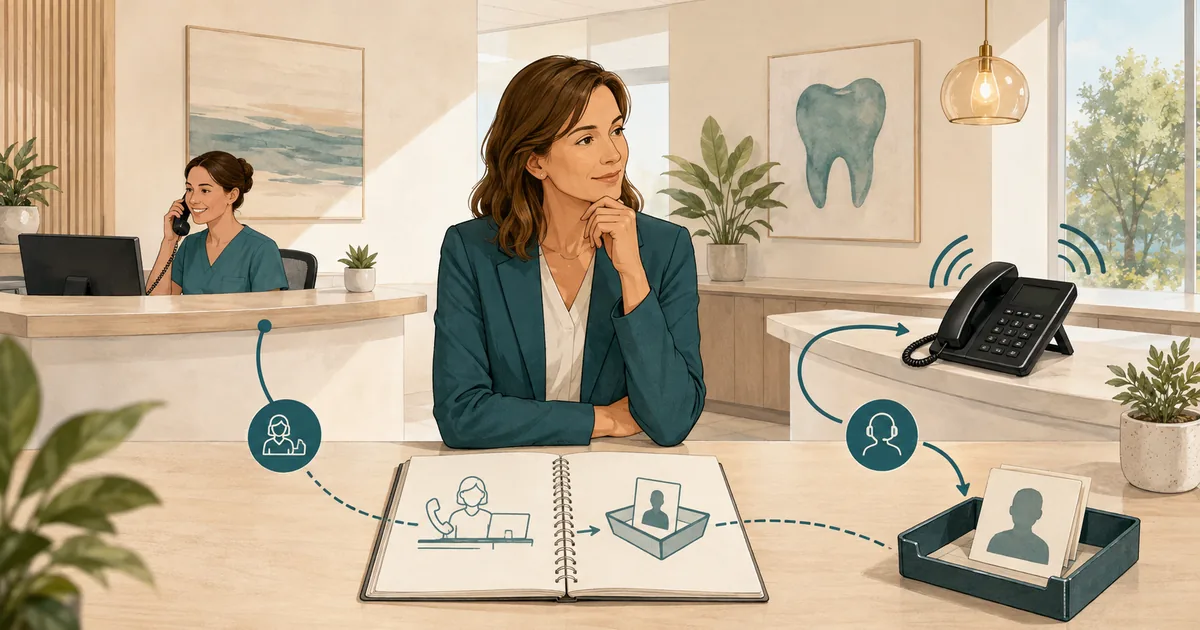
A dental answering service and a receptionist are not direct substitutes. A receptionist supports the entire in-office patient experience, while an answering service covers a defined part of the phone workflow. The right choice depends on when calls are missed, what callers need, which decisions require practice authority, and who owns follow-up after a request arrives.
For many dental offices, the most practical answer is a hybrid: the front desk answers first during staffed hours, and additional coverage handles only busy, no-answer, lunch, or after-hours calls. That model preserves the receptionist's judgment and patient relationships without leaving predictable call gaps unmanaged.
Compare roles before comparing prices
The phrase dental answering service vs. receptionist can suggest that one must replace the other. In practice, they usually operate at different scopes.
The U.S. Bureau of Labor Statistics describes receptionists as handling phones, visitors, messages, appointments, records, and general information. In a dental office, that role also sits where callers, arriving patients, clinicians, schedules, payments, and office policies meet. Review the BLS description of receptionist duties as a broad baseline, then define the additional responsibilities specific to your practice.
An answering service is narrower. Depending on the service, it may:
- answer calls in selected conditions;
- identify the practice and ask what the caller needs;
- collect a name and confirmed callback number;
- record a location and general request category;
- use approved office information;
- capture an appointment preference without promising availability;
- create a message or structured request;
- follow a written transfer or escalation rule.
It should not inherit every responsibility of the front desk merely because it answers the telephone.
Dental answering service vs. receptionist at a glance
| Decision factor | Receptionist | Answering service |
|---|---|---|
| Primary role | Supports callers, patients in the office, schedules, records, payments, and internal coordination | Covers a defined set of incoming calls and creates a handoff |
| Coverage window | Staffed shifts and office availability | Selected busy, no-answer, lunch, after-hours, or overflow conditions |
| Practice context | Direct access to coworkers, office procedures, and authorized systems | Limited to approved information, scripts, access, and routing |
| Appointment handling | May schedule or change appointments when authorized | Should capture a request unless verified scheduling access and authority exist |
| Clinical questions | Routes to an authorized clinical team member | Captures and hands off without diagnosis or non-clinical triage |
| Caller relationship | Can continue the conversation across in-person and phone interactions | Usually handles only the covered call and resulting request |
| Management | Hiring, training, supervision, scheduling, payroll, and coverage | Vendor selection, configuration, quality review, usage, and contract management |
| Failure risk | Calls compete with patients at the desk and other duties | Poor scripts, wrong routing, weak fallback, or incomplete handoffs |
| Best use | Full front-desk work and decisions requiring practice authority | Predictable gaps and standardized request capture |
The service category also matters. Some answering services use live agents, some use automation or AI, and some combine them. Do not compare labels. Compare the exact caller experience, scope, output, access, fallback, and total cost.
What a receptionist can do that coverage cannot
A capable receptionist does much more than answer calls.
Manage the physical front desk
The receptionist can see who has arrived, which employee is available, whether a checkout conversation needs privacy, and when the waiting room needs attention. Remote coverage does not have that physical context.
Use practice judgment
Experienced staff know when a routine request needs a manager, when an insurance question belongs with the benefits coordinator, and when a clinical question must move to an authorized clinical role. An answering service should follow a defined rule rather than improvise that judgment.
Complete authorized work
Depending on the role and practice policy, a receptionist may verify the schedule, confirm an approved appointment, collect or update information, process a payment, or document an outcome in an authorized system. A service without that verified access should not claim the work is complete.
Maintain continuity
A receptionist may recognize a returning caller, understand an earlier conversation, and coordinate with the team in real time. Additional coverage usually creates a request for the office to continue.
These differences are why answering coverage should not be described as a front-desk replacement. It can remove a defined call gap or collection step, but the practice still needs people to make decisions and complete follow-up.
What an answering service can cover well
Additional coverage is useful when the problem is specific and repeatable.
Simultaneous calls
When an employee is already helping a patient or speaking with another caller, a second call may go unanswered. Coverage can capture the second caller's request instead of forcing the receptionist to interrupt both conversations.
No-answer calls
If the team cannot answer within a chosen interval, the call can follow a tested route to coverage. The office should verify ring timing, caller ID, voicemail order, and fallback with its actual phone provider.
Lunch and short staffing gaps
A planned coverage window can protect a predictable break without keeping one employee tied to the phone. The lunch-hour coverage playbook explains how to assign the return queue and restore the normal route.
After-hours requests
Coverage can identify the practice, collect a general request, provide approved office facts, and set an accurate expectation for follow-up. It should not make clinical decisions or promise an appointment.
Standardized request capture
A short, consistent set of fields can produce more usable handoffs than an unstructured message:
- caller name;
- confirmed callback number;
- intended location;
- general reason for calling;
- new or existing patient status, when relevant and known;
- timing preference;
- unanswered question;
- expectation given to the caller.
The service should collect only what the next authorized employee needs. A longer intake is not automatically better.
Compare the complete cost of each model
Do not compare one monthly invoice with one hourly wage. Build a complete cost for each operating model.
Receptionist cost
Include:
- wages;
- employer payroll costs;
- benefits;
- recruiting;
- onboarding and training;
- paid leave;
- overtime or temporary coverage;
- manager supervision;
- software and workstation costs;
- the cost of leaving the role uncovered.
Use local compensation data and your own payroll assumptions. National wage figures are not a quote for your market or role.
Answering-service cost
Include:
- base subscription or minimum;
- usage charges;
- additional location or number fees;
- phone-routing features;
- setup and script work;
- manager review time;
- duplicate or failed-request handling;
- contract minimums;
- overage, transfer, message, or after-hours charges;
- exit or migration work.
The dental answering service cost guide provides a structured quote-comparison checklist.
Compare the cost of the uncovered gap
The decision is rarely “hire a full-time receptionist or buy a service.” It may be “add two hours of employee coverage, redesign the queue, or cover only simultaneous and after-hours calls.”
Measure:
- eligible calls that staff did not answer;
- usable requests created;
- staff time spent retrieving and rewriting messages;
- time from request arrival to assignment;
- duplicate work;
- overtime connected to phone backlog;
- callers reached by the office;
- appointments scheduled by authorized staff;
- completed visits attributable to those requests.
Use the same definitions before and after the change. If you need a financial model, calculate answering-service ROI from your own practice data rather than assigning a universal dollar value to every call.
Compare control, not just availability
Twenty-four-hour availability is not useful if the office cannot control what callers hear or what staff receive.
Ask both an internal staffing plan and a vendor plan:
- Who can change the greeting and approved office information?
- Which call conditions activate coverage?
- What happens when the primary destination is unavailable?
- Can the manager disable coverage without opening a support ticket?
- Who reviews request quality?
- How are corrections handled?
- How does the office prevent duplicate requests?
- Which employee owns the next step?
- What does the caller hear about timing and availability?
- How are access and retention managed when staff or vendors change?
The ADA recommends consistent greetings, scripts for common call topics, and role-playing phone scenarios. Those practices apply whether a call is answered by an employee or by external coverage. See the ADA guidance for prospective-patient phone calls.
Protect decisions that belong inside the practice
Write a clear authority boundary before coverage begins.
| Caller request | Coverage may | Practice must own |
|---|---|---|
| Basic office information | Use approved current facts | Approve and maintain those facts |
| New-patient inquiry | Collect contact details and general request | Decide next step and schedule when authorized |
| Appointment request | Record preference and callback information | Confirm availability and make the schedule change |
| Insurance question | Capture the plan-related question | Verify and explain individual benefits |
| Fee question | Use only approved general language | Provide an authorized estimate or final financial explanation |
| Clinical question | Record a general reason and follow the handoff rule | Provide clinical guidance |
| Complaint | Listen, document facts, and route | Investigate, decide, and respond |
| Urgent concern | Follow the practice-approved non-clinical instruction | Maintain the clinical and emergency process |
This boundary should appear in scripts, training, quality review, and escalation rules. It should not exist only in the sales contract.
Review privacy and access for both options
Receptionists and answering services may handle identifiable patient information. The privacy question is not “employee or vendor?” It is what information each person or system receives, why it is needed, where it goes, and who can access it.
Review:
- individual user accounts and role access;
- recordings, transcripts, messages, and summaries created;
- information exposed in ordinary email or mobile alerts;
- storage and retention;
- subcontractors;
- access removal;
- incident procedures;
- export and deletion;
- the contract governing protected information.
HHS states that when a covered entity uses a business associate to perform activities involving protected health information, the relationship generally requires a written contract defining the work and safeguards. Confirm the applicability and terms for the actual service with qualified advisors using the HHS covered-entity and business-associate guidance.
Do not assume an employee workflow is safe because it is internal or that a vendor is suitable because its website uses compliance language. Review the real data path.
Consider the main dental answering service alternatives
If a full answering service is not the right fit, alternatives include:
- improving front-desk scripts and call ownership;
- changing shifts around measured call peaks;
- cross-training a backup employee;
- using a centralized in-house call team across locations;
- adding busy or no-answer coverage only;
- using a short voicemail workflow with an owned callback queue;
- offering an approved online request path for non-urgent needs;
- combining narrower coverage methods.
Voicemail remains reasonable when gaps are small and staff reliably return complete messages. The comparison of answering service vs. voicemail explains how caller effort and request quality differ.
Avoid adding three new channels without one working queue. A voicemail, email, form, and answering service can create four copies of the same request unless ownership is explicit.
Design a hybrid model
A practical hybrid can use this order:
- The front desk answers first during staffed hours.
- A measured busy or no-answer condition sends only eligible calls to coverage.
- Coverage collects the minimum approved request.
- One queue receives the resulting handoff.
- A named employee assigns and completes follow-up.
- A documented fallback handles outages or failed transfers.
- The manager reviews a small quality sample and adjusts the workflow.
After hours, the office may use a different approved greeting, request scope, and urgent-concern instruction. Keep each coverage condition separate enough to test and reverse.
Run a controlled comparison
Before committing to a larger staffing or service change, run a short, defined pilot.
Establish the baseline
Track two to four typical weeks. Record call conditions, usable messages, request ownership, callback time, duplicate work, and front-desk handling time.
Choose one gap
Pilot one condition, such as simultaneous calls or weekday no-answer calls. Do not change every phone path at once.
Use test scenarios
Call as:
- a new patient asking for basic office information;
- an existing patient requesting a callback;
- a caller asking for a specific time;
- a caller with an insurance question;
- a caller who corrects a phone number;
- a caller for the wrong location;
- a silent caller or hang-up;
- a caller during a fallback failure.
Review what the caller heard and what the front desk received. A service passes only when the request is accurate, assigned, and usable.
Compare outcomes
At the end of the pilot, compare:
- caller effort;
- request completeness;
- routing accuracy;
- staff handling time;
- unassigned queue age;
- privacy and access issues;
- total cost;
- failures and recovery time;
- staff and caller feedback.
Do not expand because a dashboard reports more answered calls. Expand when the office receives better owned requests without losing control.
Final decision checklist
Choose or redesign the model only after you can answer:
- [ ] Which exact calls are currently missed?
- [ ] Which duties require a receptionist or another authorized employee?
- [ ] Which narrow steps can coverage perform safely?
- [ ] Who owns each resulting request?
- [ ] What information may the answering service use?
- [ ] What must it never decide or promise?
- [ ] What are the complete costs of each option?
- [ ] How do normal routing, fallback, and rollback work?
- [ ] How are privacy, access, retention, and contracts reviewed?
- [ ] What baseline and pilot measures will determine success?
A receptionist remains the center of the front-desk relationship. An answering service can protect defined call gaps. The strongest choice is the one that preserves staff authority, produces clear requests, and gives the practice a reversible operating model.