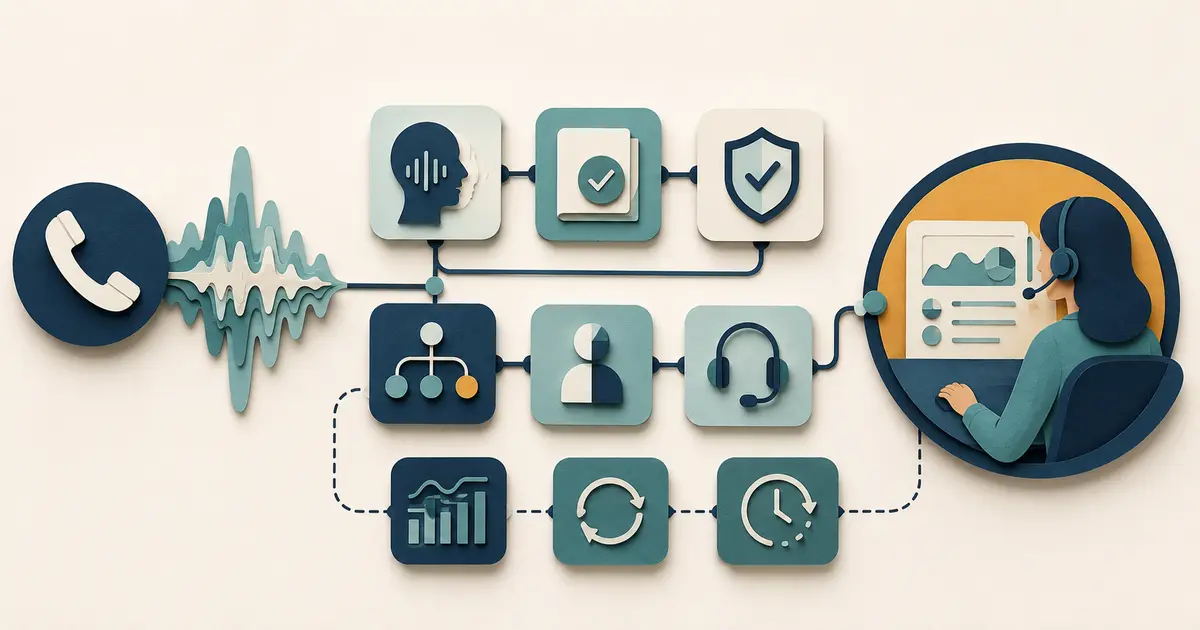
Voice AI for dental practices combines more than speech. A production call may pass through telephony, speech recognition, a conversational model, approved office knowledge, policy rules, integrations, text or speech output, logging, analytics, and a staff handoff.
Evaluate those parts as one workflow. A natural voice can still state a stale hour, mishear a correction, make an unauthorized decision, or produce an unusable request record.
Map the complete system
Ask the vendor to diagram:
- how the call reaches the service;
- where audio is processed;
- how speech becomes text or another machine representation;
- which office facts and policies are available;
- how the system selects a response or action;
- which external systems it reads or writes;
- what the caller hears;
- what record the dental team receives;
- how people monitor, correct, and stop the workflow.
The AI receptionist software requirements guide provides a buyer-level checklist. This article gives front desk teams a way to test how the components behave together.
Define the narrow use case
Start with a specific coverage condition and tasks. Examples are answering eligible ring-no-answer calls, stating approved hours, capturing a callback request, or routing an approved escalation.
Missed Calls Dental is missed-call backup for eligible forwarded calls. It saves caller requests for front-desk follow-up. It does not replace the phone system or staff, book or change appointments, diagnose, clinically triage, or verify insurance benefits.
Avoid approving “dental phone automation” as one large capability. Name each allowed action and prohibited decision.
Test speech recognition in context
Use realistic audio conditions: speakerphone, mobile connection, background voices, traffic, quiet speech, rapid speech, accents, names with unusual spelling, numbers, dates, corrections, silence, interruptions, and callers talking over the response.
Check the final structured record, not only the transcript. A system may transcribe the wrong number but summarize the call confidently. Ask the caller to correct a name, phone number, date, and location, then verify that the corrected values become current.
Use read-back selectively for high-impact details while protecting privacy in shared settings.
Verify the knowledge source
Create a versioned office profile with current hours, locations, holiday exceptions, directions, general services, accessibility and language paths, and approved administrative wording. Assign an owner to each field.
Test facts that are present, absent, outdated, and contradictory. The expected behavior for an unknown question is a visible limit and an accurate handoff—not a plausible invention.
The AI hallucination escalation guide shows how managers can define stop and transfer rules.
Draw the authority matrix
For every call type, state what the system may say, collect, route, or change. Include new-patient inquiries, existing-patient questions, appointment requests, changes, insurance, pricing, records, referrals, complaints, and possible emergencies.
Red lines should include:
- no diagnosis or treatment recommendation;
- no independent clinical urgency decision;
- no insurance coverage or patient-cost guarantee;
- no unverified final fee;
- no appointment confirmation without an authorized scheduling transaction;
- no disclosure before appropriate identity verification;
- no unsupported promise about callback timing or outcome.
The system should remain helpful by capturing the request and following the approved next step.
Inspect routing and telephony
Test the actual provider configuration for ring-no-answer, busy, simultaneous calls, closed hours, transfers, caller ID, voicemail order, and return to normal service. Phone behavior is provider-specific.
Identify what happens if the AI does not answer, the call disconnects, the vendor is unavailable, or the office disables forwarding. Preserve a fallback message and a way to reconcile pending work.
The dental phone outage plan provides a continuity checklist.
Evaluate the handoff record
A useful handoff separates routing event, caller-provided identity, callback number, request category, caller wording, approved information given, escalation, status, owner, and due rule. It preserves unknowns and corrections.
Compare source audio or another approved record with transcript, summary, structured fields, notification, and queue item. Look for omitted negation, changed dates, wrong location, missing limitations, and summaries more certain than the conversation.
Do not distribute full transcripts to every employee when a narrower structured record serves the purpose.
Test conversational recovery
Run scenarios in which the caller changes the subject, asks several questions, says “that's not what I meant,” requests a person, becomes frustrated, pauses, disconnects, or repeats the call.
The system should preserve context without trapping the caller. Define when it transfers, captures a message, or uses another approved route. Test the transfer destination being unavailable.
The human-sounding AI evaluation guide explains why naturalness matters only alongside transparency and control.
Review privacy and vendor roles
Map every organization and system that receives audio, transcript, metadata, structured fields, or analytics. Determine permitted uses, business associate relationships, subcontractors, access, encryption, logging, retention, model-improvement use, support access, incidents, exports, deletion, and termination.
HHS's minimum-necessary guidance supports limiting information to the defined purpose. NIST's AI Risk Management Framework supports governing, mapping, measuring, and managing risk across the system lifecycle.
Use qualified advisers for legal and security conclusions.
Build a regression test set
Keep a stable set of high-risk fictional calls and expected results. Include office facts, corrections, identity, insurance, pricing, appointment state, complaint, possible emergency, accessibility, unknown questions, and outages.
Rerun tests after changes to models, prompts, office knowledge, routing, integrations, vendors, or policy. Record configuration, date, evidence, defect severity, owner, fix, and retest.
Do not average a dangerous failure into an acceptable overall score.
Monitor live workflow
Track eligible calls, successful answers, abandoned calls, complete requests, corrections, escalations, delivery failures, staff edits, callback outcomes, unresolved aging, complaints, and incidents. Use practice-specific baselines and visible denominators.
Sample records under an approved quality process. Measure whether staff can act, not only whether the model responded.
Keep human control and rollback
Staff need a visible queue, authority to correct records, a way to report defects, and a tested process for stopping the system. Document how to disable forwarding, preserve requests, revoke access, export data, and restore manual coverage.
Voice AI is valuable only when the practice can explain what it does, prove what it did, and take control when it fails. Evaluate the complete system rather than the voice at the front of it.
Create a component-level defect map
When a call fails, identify where it failed: telephony, recognition, office knowledge, policy, model response, integration, speech output, delivery, queue, or staff follow-up. Preserve the evidence needed by each owner without exposing more patient information than necessary.
Use severity and recurrence together. A rare privacy disclosure or clinical invention is still high risk. A frequent minor recognition error may create large operational rework. Track whether a fix changes another component and rerun adjacent tests.
Maintain a current diagram, vendor contacts, configuration versions, and stop procedure. During an incident, the practice should know whether to disable forwarding, remove a knowledge entry, revoke an integration, pause a message, or increase staff review. Component visibility makes rollback faster and prevents the team from blaming every problem on “the AI.” Review repeated defects with the component owner and verify the correction with the same call scenario.