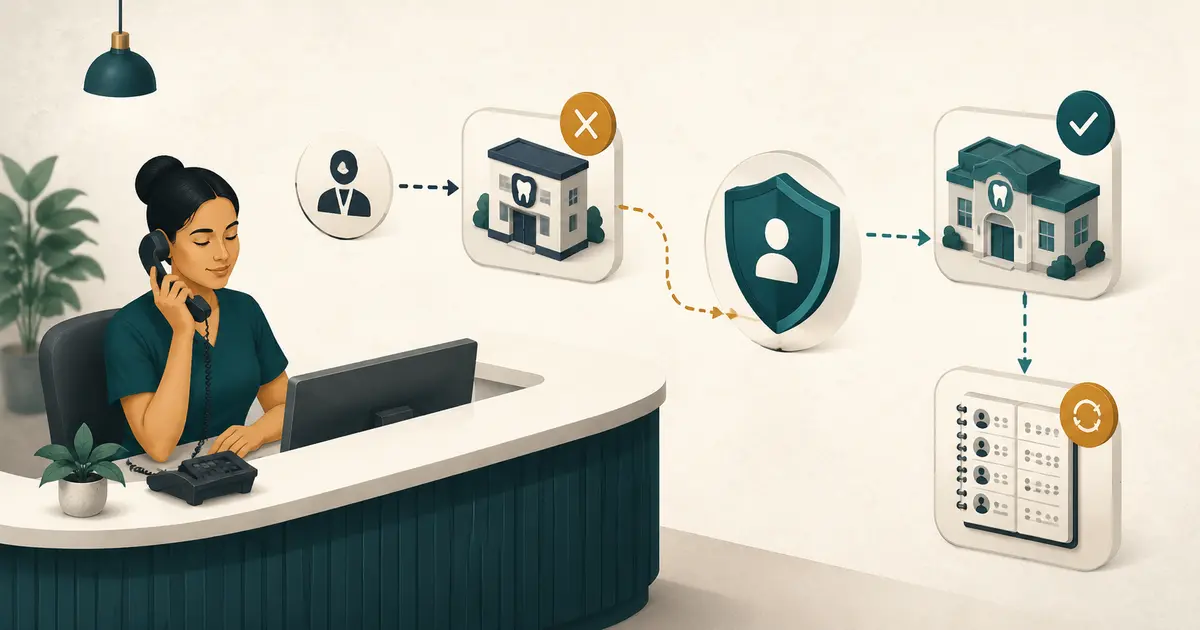
A dental wrong-number call procedure helps staff end misdirected calls without revealing information, guessing at another office's number, or allowing recurring routing problems to remain invisible. Most cases are simple; the control matters because a wrong-number caller may name a patient, repeat information from a message, or reach the office through a broken listing.
Clarify the destination neutrally
State the practice name and ask which office or service the caller intended to reach. If it is not your practice, a safe response is:
“You've reached [Practice Name]. We are not the office you named, so I can't access or confirm their information. Please use a trusted directory or a number you have independently verified.”
Do not confirm whether a named person is a patient, employee, former employee, clinician, or vendor. Do not search internal records merely to satisfy a caller who reached the wrong destination.
Avoid guessing or transferring blindly
Only provide another organization's public number when the practice has an approved, current source and a legitimate reason to do so. Otherwise direct the caller to the organization's official website, insurance directory, referring office, or another trusted source.
Do not transfer a caller to an internal extension, personal number, or partner merely because the names sound similar. A blind transfer can turn a harmless mistake into a privacy or security problem.
Limit what enters the call record
Record the minimum needed to identify an operational pattern:
- date and time;
- dialed practice number;
- broad intended destination, if volunteered and needed;
- likely source such as search listing, printed card, referral, or prior callback;
- disposition and whether the pattern is recurring;
- owner, correction task, and verification.
Do not copy a patient's story, clinical details, account information, or identifiers into a wrong-number log. If sensitive information was exposed or sent to the practice, notify the privacy or security owner under the incident process rather than spreading it in routine notes.
Investigate repeat calls
One mistaken digit may need no follow-up. Repeated calls for the same other office can indicate a stale directory, reused number, incorrect advertisement, caller-ID display, forwarding error, or number-port issue. Check the call-tracking number inventory and routing change management plan.
Verify the correction from outside the office. Search the exact listing, use click-to-call, place a fictional call, and document the result. If the wrong calls begin after an outage or number change, connect the pattern to the phone-number launch checklist.
Handle mistaken callbacks carefully
A person may say, “You called me.” Confirm only what the practice can verify from approved call logs and permitted information. Do not reveal the identity or reason associated with another caller. If a number appears to have been entered incorrectly, route the correction to the authorized workflow.
For threats, fraud attempts, harassment, or repeated automated traffic, follow the practice's security and escalation procedures. Front desk staff should not investigate beyond their role.
Missed Calls Dental boundary
Missed Calls Dental can capture an administrative caller request on an eligible forwarded call. It does not own public directories, carrier number assignment, or the practice's privacy response. The practice owns number accuracy, identity decisions, incident escalation, listing corrections, and closure.