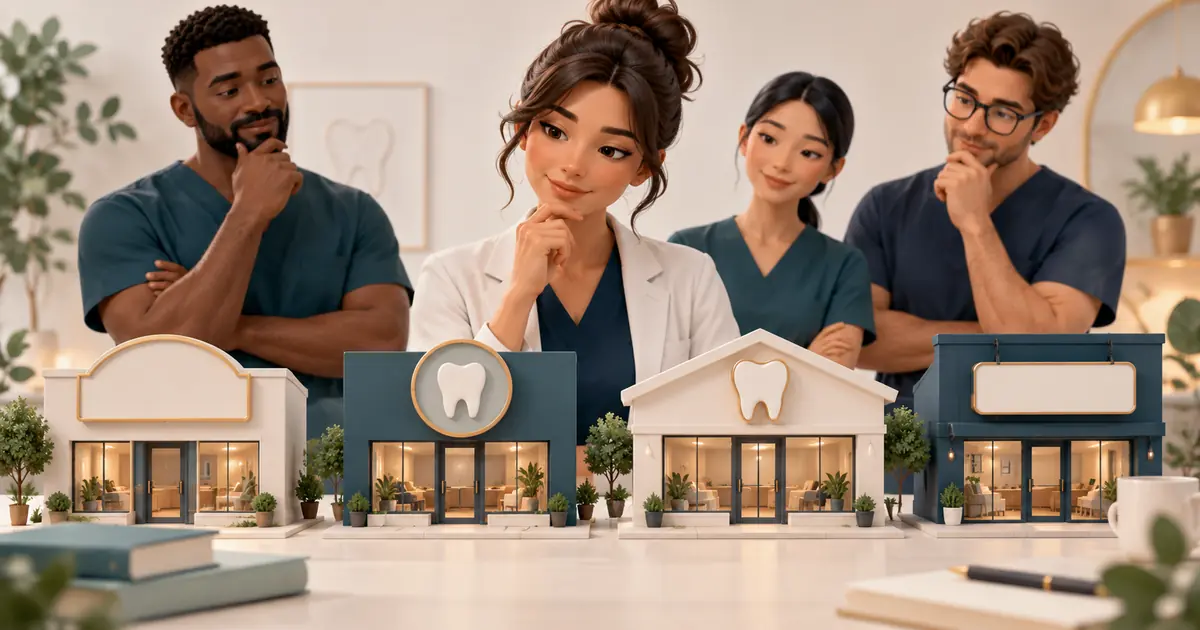
Good dental practice name ideas are easy to understand, suitable for the practice you intend to build, and capable of passing professional and legal review. Generate several directions, test how people hear and remember them, then screen the strongest candidates before buying signs or announcing the business.
The objective is a name patients can use confidently. A clever phrase that people cannot spell, a location that becomes misleading, or an identity confused with another office creates work every time someone tries to find you.
Decide what the name needs to communicate
Write a short naming brief from the service model in your dental practice business plan. Include the actual service area, practice type, intended patient groups, likely ownership changes, and any realistic expansion plans.
Choose two or three qualities you want the identity to suggest, such as approachable, established, or straightforward. Then list boundaries: no unsupported quality claim, no implication of a specialty the practice cannot lawfully represent, and no location reference that misdescribes the office.
Decide whether the name should stay useful if an associate joins or the founder eventually leaves. A founder's name can support personal recognition, while another naming direction may better suit a future ownership change. Neither choice removes the need for legal screening.
Explore six naming patterns
These are illustrative pattern examples only. Their availability, trademark status, and compliance with any state's dental rules have not been checked. They are starting points for brainstorming, not approved names to adopt.
| Pattern | Illustrative example | Question to test |
|---|---|---|
| Neighborhood plus dental descriptor | Juniper Crossing Dental | Does the reference accurately describe the location? |
| Street plus office descriptor | Alder Avenue Dental Office | Would a future move make the identity confusing? |
| Founder plus dental descriptor | Morgan Reyes Dental Practice | What would happen to the name after an ownership change? |
| Nature word plus descriptor | Lantern Grove Dental | Will people recall the correct word order? |
| Invented word plus descriptor | Velmora Dental Practice | Can a listener pronounce and spell it? |
| Community reference plus descriptor | Harbor District Dental Group | Is the geographic and organizational impression truthful? |
Generate alternatives across several patterns before refining one. If every candidate starts with the same generic word, you have a narrow shortlist even if it contains twenty entries.
Clarity and distinctiveness can pull in different directions. The USPTO explains that suggestive, arbitrary, and fanciful marks are generally stronger than descriptive terms, while generic terms cannot function as trademarks for the goods or services they name. That principle does not establish whether any example above is registrable. USPTO guidance on strong trademarks.
Test the name in ordinary patient tasks
Ask a few people outside the naming discussion to complete the same small exercise for each candidate. Treat their responses as usability feedback, not statistically representative market research.
- Hear it once: say the proposed phone greeting without showing the name. Ask them to repeat it and write what they heard.
- Find it later: after another topic, ask which words they remember. Note omissions and substitutions.
- Explain the business: show the name without a logo. Ask what kind of organization they expect and where they think it operates.
- Read it small: place the text in a plain mobile header and on a sample appointment card. Check whether shortening it changes its meaning.
- Distinguish it: compare it with nearby practice names found during screening. Ask where a wrong-office call might arise.
Record observations rather than votes alone. “Three people wrote the first word differently” identifies a practical problem. “Everyone liked the blue logo” tells you little about the name.
Use the patient tasks in the dental website design checklist to check the eventual presentation. Keep visual polish out of the first naming test so it does not hide ambiguity.
Screen four different kinds of availability
A single successful search is not clearance. Business names, public trade names, trademarks, and website addresses have different functions.
| Check | What to establish | What it does not establish |
|---|---|---|
| State entity registry | Whether the legal entity name meets filing rules | Freedom from trademark infringement |
| Assumed-name or DBA registration | Which trade-name filings the jurisdiction requires | Exclusive rights simply because a DBA is filed |
| Trademark review | Potential conflicts involving related services and earlier rights | A guaranteed registration or dispute-free future |
| Domain and account availability | Whether the intended address or account can be obtained | Legal permission to use the business identity |
The SBA treats these registrations as legally independent and notes that a DBA filing alone does not provide legal protection. Have counsel confirm the requirements for your entity and location. SBA guidance on choosing and registering a business name.
For trademark screening, look beyond exact matches. The USPTO recommends reviewing registered and pending marks, relevant state records, and internet evidence of common-law use. Similar marks used for related services can present conflicts; an earlier user may have rights without federal registration. An experienced trademark attorney can interpret the findings. USPTO's comprehensive clearance-search guidance.
Maintain a search log for each serious candidate: exact spelling, variants examined, source, date, possible conflict, and reviewer conclusion. Keep unresolved findings visible. Adding a city name, punctuation, or “dental” should not be assumed to cure a conflict.
Check dental naming rules before final design
Professional rules add another review. Ask the state dental board and counsel about required identifiers, permitted entity suffixes, specialty implications, fictitious-name permits, ownership restrictions, and how the dentist's identity must appear.
For example, California requires a board-issued fictitious-name permit for covered dental offices practicing under a fictitious name; a county fictitious-business-name statement does not satisfy that requirement. Its naming provisions also specify required dental designations. Those are California requirements, not a nationwide naming formula. Dental Board of California's fictitious-name guidance.
Treat an unresolved professional-rule issue or material trademark conflict as a reason to pause that candidate. A popularity score cannot override either.
Select the finalist and control its rollout
After the necessary screening, score the remaining candidates from zero to two on five practical dimensions: spoken clarity, spelling, recall, fit with the service model, and usefulness after foreseeable changes. Use the total to structure discussion, then review the actual observations behind it.
Keep a backup candidate until the required filings and permissions are confirmed. Record who approved the final spelling, public display form, legal entity name, and any separate trade name. Have the practice control its domain and related accounts through appropriate organizational access.
Before launch, compare the sign proof, website, phone greeting, forms, receipts, and payer-facing details with that approved record. Use the local SEO checklist to maintain accurate public information. Recheck the identity whenever a move, new owner, or service change makes the original naming assumptions obsolete.