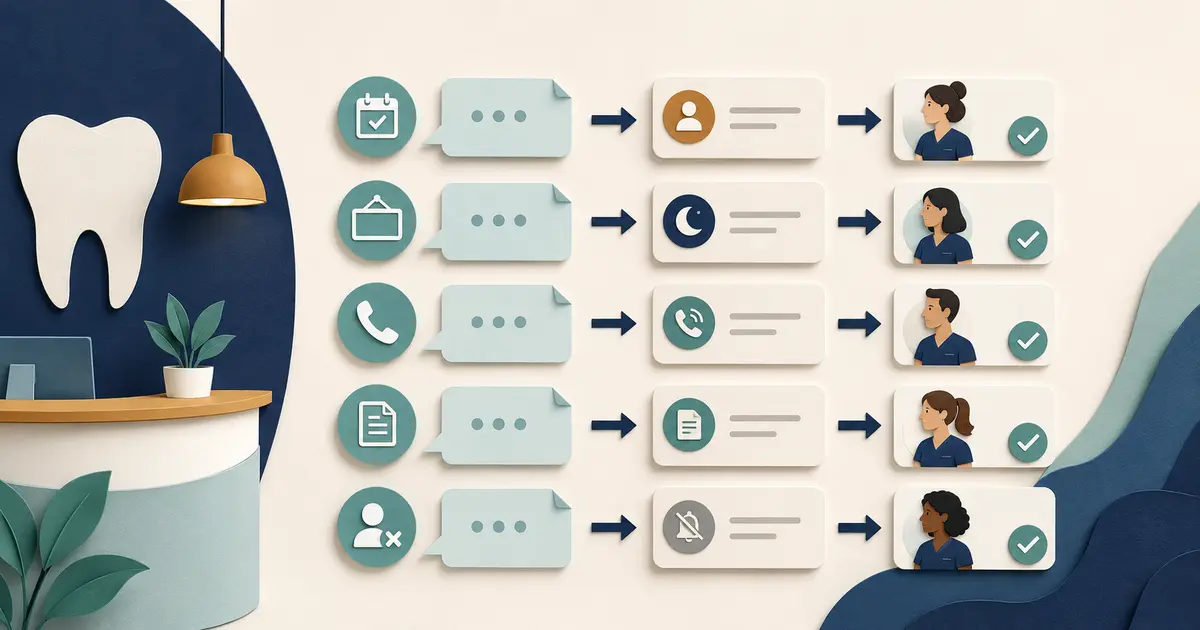
Dental patient text message examples work best when each template corresponds to a real workflow state. A request-received message should not sound like a confirmed appointment. A callback notice should not expose the reason for care. A change message should not rely on stale schedule data.
Use these examples as starting points. Have qualified advisers approve the practice's privacy, consent, communication, accessibility, and legal requirements.
Set template rules first
Every message should:
- identify the practice;
- say what is true now;
- use minimum necessary detail;
- give one clear action or next step;
- provide a workable correction path;
- follow the approved purpose and contact preference;
- honor applicable opt-out and suppression rules.
Do not include diagnosis, treatment detail, full insurance information, or sensitive balances when a neutral message and secure channel serve the purpose.
The patient texting best practices guide explains the underlying governance.
Appointment request received
Use this when the office has a request, not a booking:
“[Practice]: We received your appointment request. Our team will review availability and contact you. This message does not confirm an appointment. Reply STOP to opt out where applicable.”
If the practice uses another approved opt-out method or wording, follow it. Do not insert a date or provider unless the source state supports it.
Missed Calls Dental can capture eligible missed-call requests for front-desk follow-up. It does not book appointments, so its follow-up language should preserve the request state.
Staff review required
Use when the team needs more information:
“[Practice]: We are reviewing your request and need to speak with you before confirming the next step. Please call [approved number] or reply with a good callback time.”
Avoid naming a procedure or concern in the message. If a secure portal or form is required, link only the approved destination and explain its purpose.
Appointment confirmed
Send only after the authoritative schedule confirms the appointment:
“[Practice]: Your appointment is confirmed for [date] at [time] at [location]. Reply C to confirm or call [number] if this information is incorrect. Please do not send sensitive health information by text.”
The practice may use different confirmation tokens or channels. Validate all variables. The ADA advises recording patients' preferred reminder methods and choosing timing that works for the patient base.
Confirmation requested
When the appointment exists but the practice wants acknowledgement:
“[Practice]: Please confirm your appointment on [date] at [time] by replying [approved response] or calling [number]. Contact us if you need to request a change.”
Do not say a reply automatically changes or cancels the appointment unless the system and policy truly support that transaction.
Change request received
Preserve the current appointment until staff acts:
“[Practice]: We received your request to change an appointment. Our team will review the current schedule and contact you. The appointment remains unchanged until we confirm otherwise.”
This prevents a patient from assuming a cancellation occurred merely because a message was delivered.
The cancellation management guide explains the authoritative state transitions.
Cancellation confirmed
Use only after the schedule update succeeds:
“[Practice]: Your appointment on [date] at [time] has been canceled. If you would like our team to contact you about another time, reply YES or call [number].”
Review whether appointment type or other details should be omitted. Suppress outdated reminders and test every connected system.
Callback after a missed call
Keep it neutral:
“[Practice]: We noticed we missed your call. If you still need assistance, reply with a good callback time or call us at [number]. Please avoid sending sensitive health information by text.”
Do not state why the person called. Do not claim that a text was automatically authorized merely because a call occurred; follow the practice's approved communication and legal process.
Keep missed-call callback language neutral and state only what the office can verify.
No immediate availability
Avoid promising a slot:
“[Practice]: We do not have a confirmed time matching your request yet. Our team can review other options and contact you. Reply with your preferred days or call [number].”
If the practice maintains a waitlist, explain whether the reply requests consideration rather than guarantees an opening.
Waitlist opening offered
Use precise hold language:
“[Practice]: An appointment time may be available on [date] at [time]. It is not confirmed yet. Reply [approved response] by [time] and our team will confirm whether it is still available.”
Do not send the same exclusive offer to multiple people without a controlled rule. The waitlist automation guide explains offer, hold, expiration, and confirmation.
Information or record request
Direct the patient to a secure approved process:
“[Practice]: To continue your request, please use our secure [form/portal] at [approved link] or call [number]. Do not send records or sensitive health details in this text thread.”
Validate the link and destination. Avoid shortened URLs that make the practice identity unclear unless the organization has approved them.
Insurance or estimate follow-up
Keep benefits and prices conditional:
“[Practice]: Our team received your insurance or estimate question and will review the available information. Benefit information and estimates are not guarantees of coverage or final payment. Please call [number] with questions.”
Have financial and legal advisers approve actual language. Do not include plan identifiers or treatment details unnecessarily.
Delayed response or system issue
If the practice knows follow-up is delayed:
“[Practice]: We received your request, but our response is delayed. Our team is reviewing open messages. If you believe this is a life-threatening emergency, call 911 or go to the nearest emergency department.”
Do not use an outage message as clinical triage. Include the practice's approved emergency path where appropriate.
Wrong number response
When someone reports a wrong number:
“[Practice]: Thank you for letting us know. We have recorded this number as incorrect for this message and will review our records. We will not ask you for another person's information.”
Suppress future sends under the approved process. Do not reveal the intended patient's name or appointment.
Opt-out acknowledgement
Use the provider and counsel-approved response:
“[Practice]: You have been opted out of applicable text messages from this number. Contact [number] to discuss other communication options.”
Test that the suppression state reaches every sending workflow it should. Preserve date, time, number, purpose, and evidence.
The SMS consent and opt-out guide provides a detailed checklist.
Test every template
Use fictional or approved records to test missing variables, long names, multiple locations, daylight-saving changes, canceled appointments, staff edits, duplicate sends, delivery failure, replies after hours, opt-out, wrong number, and a link opened on mobile.
Compare source state, rendered message, delivery state, reply, queue owner, authoritative schedule, and final outcome. A template passes only when the message remains true during failures.
Govern the library
Record template purpose, owner, approval, version, variables, trigger, eligible audience, quiet hours, opt-out effect, alternate channel, and retirement date. Limit who can edit or activate templates. Audit unexpected changes.
HHS's minimum-necessary guidance supports limiting protected information to the purpose. The FCC and ADA provide resources relevant to unwanted texts and appointment communication; counsel should apply current requirements to the actual workflow.
Clear dental appointment text message examples do not try to say everything. They describe one verified state and help the patient take one safe next step.