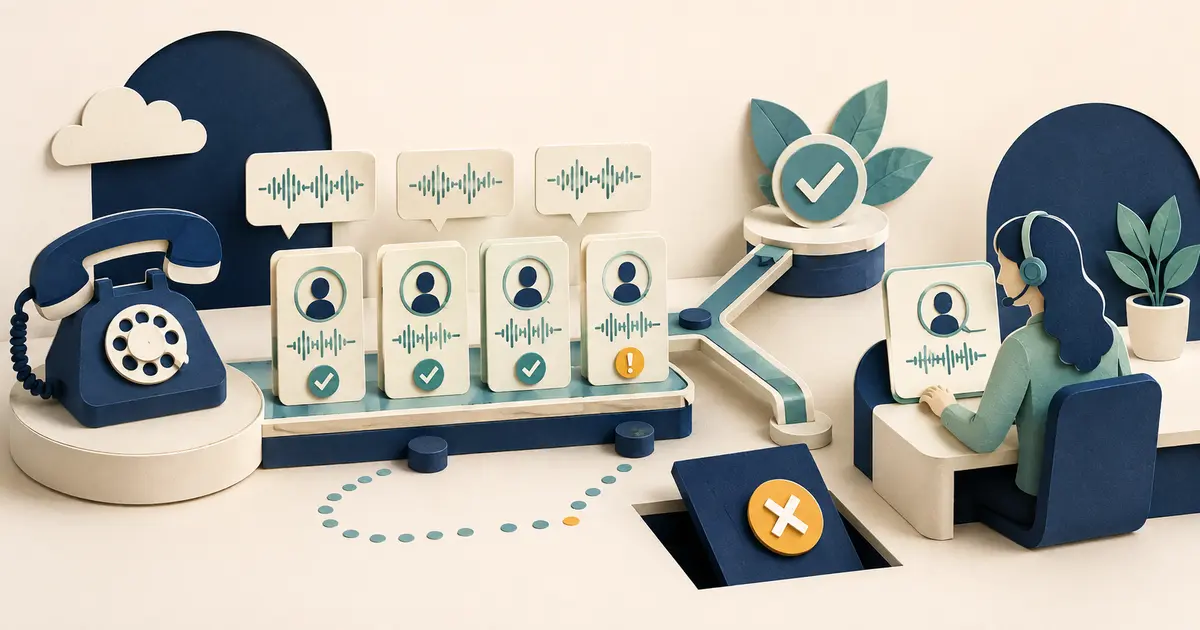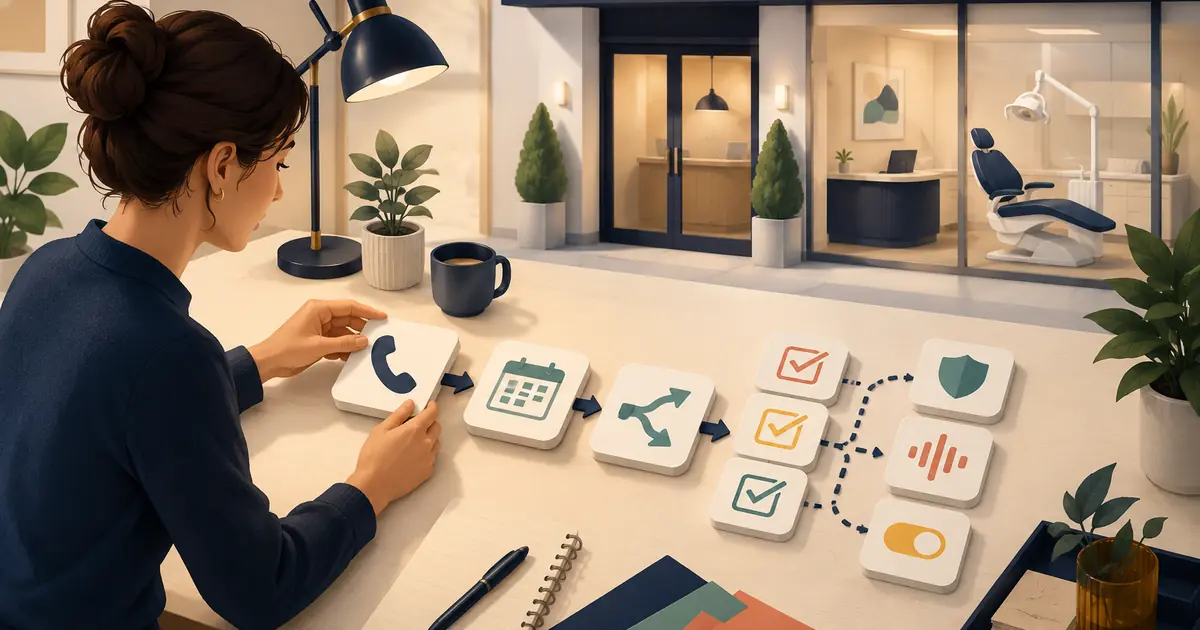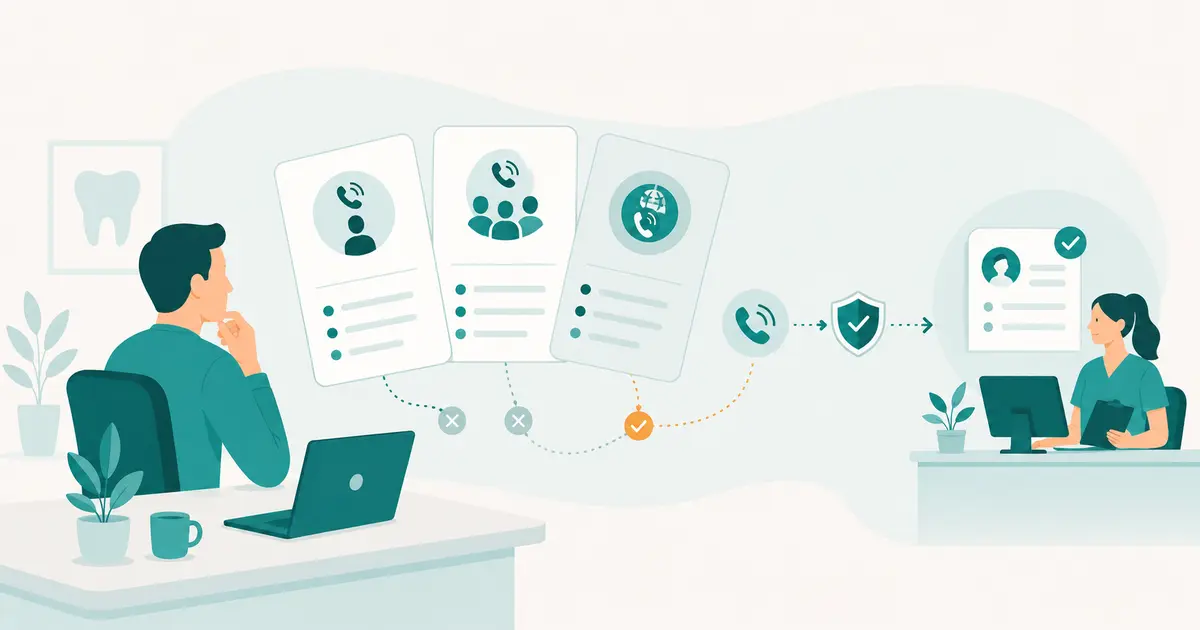
The best AI receptionist for dentists is not the product with the longest feature list or the most human-sounding demo. It is the one that handles the calls your practice actually needs covered, stays within clearly defined clinical and administrative limits, and gives your team a reliable request they can act on.
Evaluate the complete workflow: how a call reaches the service, what the AI says, what happens when it does not know an answer, what the front desk receives, how patient information is protected, and how the practice regains control. A polished conversation is useful evidence, but it is only one part of the decision.
Define the job before comparing vendors
Write a one-page call-coverage brief before booking demos. Without it, every vendor can appear to be the best dental AI receptionist because each presentation emphasizes different strengths.
Define:
- which locations and phone numbers are in scope;
- which conditions send calls to AI: busy, no answer, overflow, after hours, or direct routing;
- which caller requests the AI may capture;
- which approved office facts it may provide;
- which questions must always return to staff;
- which situations use the practice's approved urgent or emergency process;
- what information the front desk needs in the handoff;
- who owns follow-up during and after business hours;
- how the office turns coverage off if the workflow is not performing as expected.
This brief prevents a common buying error: selecting a capable product that solves a different problem. If you are still deciding between automated and human coverage, compare AI call answering with a traditional dental answering service before evaluating individual vendors.
Use three pass-or-fail gates first
Some requirements should not be averaged into a feature score. Treat them as pass-or-fail gates.
The AI stays within safe boundaries
The system should not diagnose, recommend treatment, provide clinical triage, promise appointment availability, or confirm individual insurance benefits. It should identify uncertainty, capture the caller's request in neutral language, and follow the practice's approved handoff rule.
The practice keeps operational control
Your team should understand exactly which calls reach the AI, how to change that routing, and what happens when the service is unavailable. A practice should not need to replace its entire phone system merely to test one coverage window.
The front desk receives an actionable handoff
Ask to see the actual output, not only the caller experience. The handoff should make clear who called, how to return the call, which location the request concerns, why the person called, what remains unanswered, and when the conversation occurred.
If a product fails one of these gates, a strong voice, lower price, or large integration list does not repair the underlying risk.
AI receptionist evaluation checklist
Use the same evidence request for every vendor. Mark a requirement complete only after you have seen it work, found it in the contract or documentation, or verified it during a controlled pilot.
| Evaluation area | Questions to ask | Evidence to require |
|---|---|---|
| Call scope | Which call conditions and request types can the system handle? | A diagram using your real office call path |
| Dental workflow | How does it handle appointment requests, existing-patient questions, multiple locations, and unknown office facts? | Live scenario tests and sample handoffs |
| Safety limits | What prevents clinical advice, triage, availability promises, and benefit confirmation? | Demonstrated boundary responses and written rules |
| Office knowledge | Who approves hours, services, insurance language, payment information, and policies? | An update-and-approval demonstration |
| Staff handoff | Where do requests appear, and what context is preserved? | The exact summary or queue item staff will receive |
| Phone control | How are busy, no-answer, overflow, and after-hours calls routed? | Provider requirements, setup steps, and shutoff instructions |
| Reliability | What happens during an outage, failed transfer, incomplete call, or poor connection? | Fallback behavior and service commitments |
| Privacy and security | What data is collected, stored, shared, retained, and deleted? | Contract terms, security documentation, and applicable BAA |
| Administration | Which roles can change office facts, routing, users, and access? | Role and change-control demonstration |
| Cost | What usage, locations, numbers, features, support, and overages affect the bill? | A quote modeled on the same call sample |
The checklist is intentionally evidence-based. “Designed for dental offices” is positioning. A successful test with your request types, approved information, and front-desk workflow is evidence.
Test the conversations that expose weak systems
A sales demo usually follows a clean path. Your test should include uncertainty, interruptions, and requests the AI must not complete on its own.
| Test call | Acceptable behavior |
|---|---|
| Ask for regular office hours | Uses the approved current hours and identifies the correct location |
| Ask a question not in the office knowledge | Says the office will follow up instead of guessing |
| Request a new-patient appointment | Captures the request without promising a time |
| Ask to cancel or reschedule | Documents the request unless a verified, practice-approved scheduling workflow exists |
| Ask whether a specific procedure is covered by insurance | Avoids confirming individual benefits and hands the question to staff |
| Describe an urgent dental concern | Follows the practice-approved process without diagnosis or clinical triage |
| Interrupt, change the subject, or correct a name | Recovers without losing the original request or inventing details |
| Call while the service or transfer path is unavailable | Uses the documented fallback and preserves a way for the office to respond |
Run the same scenarios with every finalist. Use different callers and ordinary mobile connections. Note where the AI asks repetitive questions, talks over the caller, loses corrections, or creates an incomplete summary.
The broader guide to what an AI dental receptionist can and cannot do can help your team agree on the boundaries before testing begins.
Inspect the handoff as carefully as the voice
The caller hears the conversation once. The front desk may work from its output for the rest of the day.
Review whether the handoff:
- separates the caller's own request from the AI's summary;
- preserves the callback number and intended location;
- identifies unanswered questions instead of hiding them;
- distinguishes a new request from a duplicate attempt when possible;
- lets staff find the conversation without searching several systems;
- supports clear ownership and a next action;
- avoids turning every call into a long transcript that staff must reread.
A concise summary and an available transcript serve different purposes. The summary should help staff act quickly; the transcript should provide context when the summary needs review.
Verify phone setup and control
Ask the vendor to map your exact phone path. A general statement that setup is easy is not enough.
For conditional forwarding, verify that your phone provider supports the required busy, no-answer, unavailable, or after-hours rules. Confirm whether the original caller ID is preserved and make sure voicemail does not answer before forwarding occurs. Test each condition from an outside number.
Also ask:
- Can coverage begin with one location or one time window?
- Can the office keep its existing published number?
- Who changes forwarding rules—the practice, the phone provider, or the vendor?
- How quickly can the practice return calls to its normal path?
- What happens to calls during internet, carrier, or vendor interruptions?
- Does adding a location require new routing, numbers, or administration?
The right answer depends on your current provider and office workflow. Do not accept a universal setup promise that has not been tested against both.
Review privacy, security, and data terms
Start with a data-flow explanation in plain language. Ask what the service creates from each call—audio, transcripts, summaries, contact details, metadata, or analytics—and where each item goes.
If your practice is a HIPAA covered entity and a vendor creates, receives, maintains, or transmits protected health information on its behalf, determine whether a business associate relationship applies. The U.S. Department of Health and Human Services explains that covered entities generally need written contracts with business associates that define permitted uses and require appropriate safeguards. Review the HHS business associate guidance with your privacy or legal advisor rather than relying on a “HIPAA compliant” badge.
Ask the vendor:
- Will it sign the agreement your practice requires?
- Which subcontractors can access or process call data?
- How are data encrypted in transit and at rest?
- Which users can access calls, summaries, and settings?
- Are access and administrative changes recorded?
- How long are audio, transcripts, summaries, and backups retained?
- How can the practice export or delete its data?
- What is the incident-notification process?
- Is practice data used to train shared models, and can that use be prohibited?
If calls are recorded or transcribed, have qualified counsel verify the notices, consent, retention, and jurisdiction-specific requirements that apply to your practice. A vendor contract does not replace the practice's own legal review.
NIST's voluntary AI Risk Management Framework also emphasizes defining roles, measuring performance, managing risk, and maintaining human oversight. For a dental office, that means naming who approves office information, reviews exceptions, monitors call quality, and can stop the workflow.
Compare total cost on the same call sample
Do not compare one vendor's base subscription with another vendor's estimated full bill. Give every finalist the same representative sample:
- number of locations;
- coverage hours and call conditions;
- expected AI answered call time or call count;
- required phone numbers;
- users or staff roles;
- setup and support needs;
- expected seasonal or campaign peaks.
Then list the base fee, included usage, overage, location or number charges, setup, support, minimum term, cancellation terms, and data-export costs. The dental answering service cost guide provides a fuller quote-comparison method.
Price still should not be separated from staff work. A less expensive service may cost more operationally if employees must reconstruct incomplete messages, check several queues, or call patients again to learn why they contacted the office.
Pilot one narrow call path
Start with one location, one coverage window, or one forwarding condition. Before the pilot, record the current missed-call and callback process using consistent definitions.
During the pilot, review:
- calls that correctly reached the AI;
- usable requests delivered to staff;
- incomplete or duplicate handoffs;
- unknown questions that were escalated correctly;
- unsupported statements or promises;
- caller corrections the AI did or did not preserve;
- staff time required to review and follow up;
- routing failures and fallback behavior;
- caller or staff confusion about the next step.
Do not use a universal pass rate copied from another practice. Set your own non-negotiable safety rules and service expectations before the pilot, then compare the result with your actual baseline. Expand only when the complete workflow improves and the team knows how to operate it.
How to make the final decision
Separate disqualifiers from tradeoffs.
Disqualifiers may include guessing about office facts, making clinical or scheduling promises outside the approved scope, an unusable front-desk handoff, unclear data terms, missing contractual safeguards where required, or no reliable way to stop or bypass coverage.
Tradeoffs include voice style, the breadth of nonessential features, pricing structure, reporting depth, or how much configuration the office prefers. Weight those according to your practice rather than a generic online ranking.
The best choice is the service that passes the non-negotiable gates, performs well on your real test calls, fits the team's daily workflow, and has costs and contract terms the practice understands.
Where Missed Calls Dental fits
Missed Calls Dental is designed for eligible missed, busy, overflow, and after-hours calls forwarded to an MCD AI number. AI Answering can use approved common office information, capture the caller's request, and create a transcript and summary in Workspace for front-desk follow-up.
It does not replace the front desk or the office phone system, book appointments, diagnose, provide clinical triage, confirm individual insurance benefits, or collect payment. The practice keeps its existing office number and controls when supported call forwarding is active.
To evaluate the workflow rather than rely on a feature list, review how Missed Calls Dental handles a forwarded call and use the live demo with the same scenarios you would give another finalist.