The phrase “AI dental receptionist” can describe very different products. Some answer only overflow calls. Others provide website chat, texting, scheduling tools, or integrations with practice software. Before evaluating a product, separate the label from the actual workflow.
For a dental office, the safest and most useful AI tasks are narrow, repeatable, and based on information the practice has approved.
What AI call answering can do well
Answer common office questions
An AI system can respond to questions about published office information, such as location, regular hours, services offered, accepted payment methods, or general office policies. The information must be kept current. If the system does not know an answer, it should say the office will follow up rather than inventing one.
Capture the reason for a call
A caller may want a cleaning, have a billing question, need to change an appointment, or ask whether the office offers a particular service. AI can collect that request and place it into a consistent summary for staff.
Create a readable handoff
The most useful output is not a long raw conversation. It is a clear request that lets a team member understand why the patient called, what information was collected, and what remains unresolved. A transcript can provide context, but the summary should support quick action.
Provide coverage during predictable gaps
AI may help when the office is closed, all staff members are helping patients, or calls arrive at the same time. Call-forwarding rules let the practice decide when the AI receives calls.
What it should not do on its own
Diagnose or provide treatment advice
AI call answering is not a clinician. It should not interpret symptoms, recommend treatment, advise on medication, or decide how urgent a dental concern is. The practice's established clinical and emergency procedures remain in control.
Act as an emergency service
An automated system should clearly state that it is not an emergency service. Medical emergencies belong with emergency services, while dental concerns should follow the practice's documented after-hours or on-call process.
Confirm insurance benefits
A general statement that a practice works with an insurance plan is different from confirming a patient's eligibility, coverage, deductible, or expected payment. Those details require verification through the practice's normal process.
Promise an appointment
Collecting an appointment request is not the same as booking or confirming a time. Unless a system has a verified, current scheduling connection and the practice has approved that exact workflow, it should not promise availability.
Replace front desk judgment
Some conversations need empathy, context, or a decision that falls outside a script. The front desk should remain responsible for reviewing requests, resolving uncertainty, and following up with the patient.
A practical evaluation checklist
Ask a vendor to show the actual call flow, then verify:
- whether callers are clearly told they are speaking with an AI assistant;
- which office facts the AI may use and who keeps them current;
- what happens when a question is unknown or outside scope;
- how staff receive and organize requests;
- whether the system makes unsupported scheduling, insurance, or clinical claims;
- how the office controls call forwarding and can stop it;
- what happens when the service is unavailable.
How to introduce AI to the front desk
Treat AI as a coverage channel, not a staff replacement. Start with a small set of call conditions, review the requests it captures, and identify where office information needs clarification. Give staff one clear place to see the request and one agreed process for follow-up.
The front desk should also know what the AI cannot do. That makes exceptions easier to spot and prevents the team from assuming that an appointment, benefit, or clinical question has already been resolved.
What Missed Calls Dental does
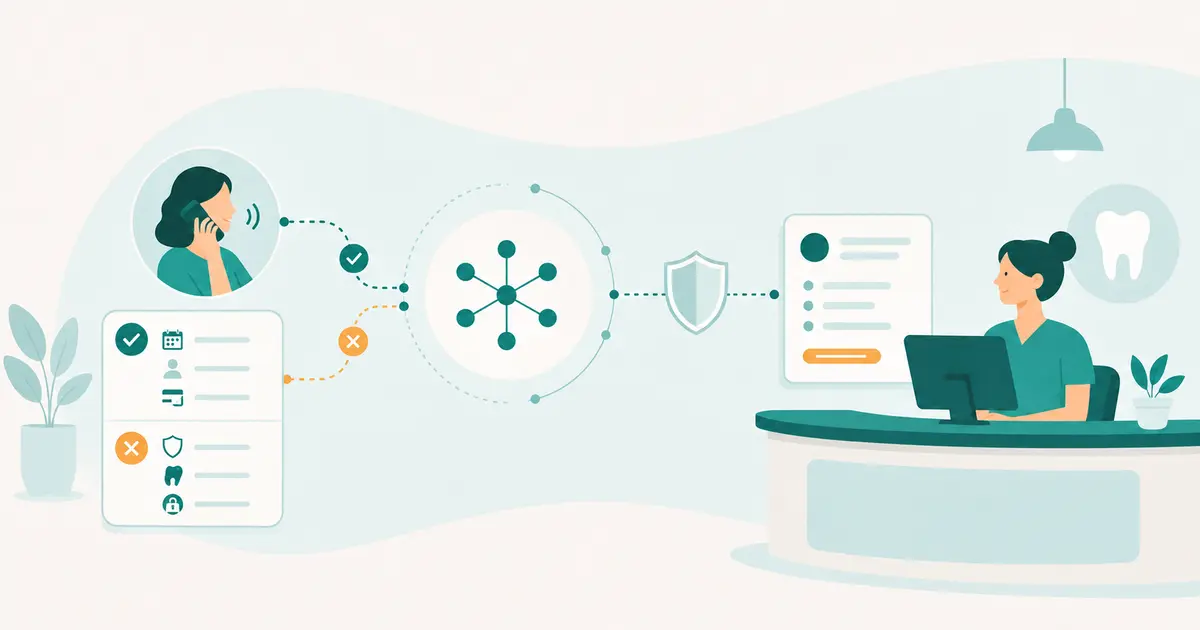
Missed Calls Dental focuses on eligible forwarded calls. It can answer approved common office questions, capture a caller's request, and provide the front desk with a transcript and summary in Workspace. Staff then review the request and decide the next step.
It does not provide diagnosis or emergency triage, confirm insurance benefits, collect payment, or book appointments. You can hear the intended experience on the sample call page and learn how to structure coverage in How to Handle After-Hours Calls at a Dental Office.