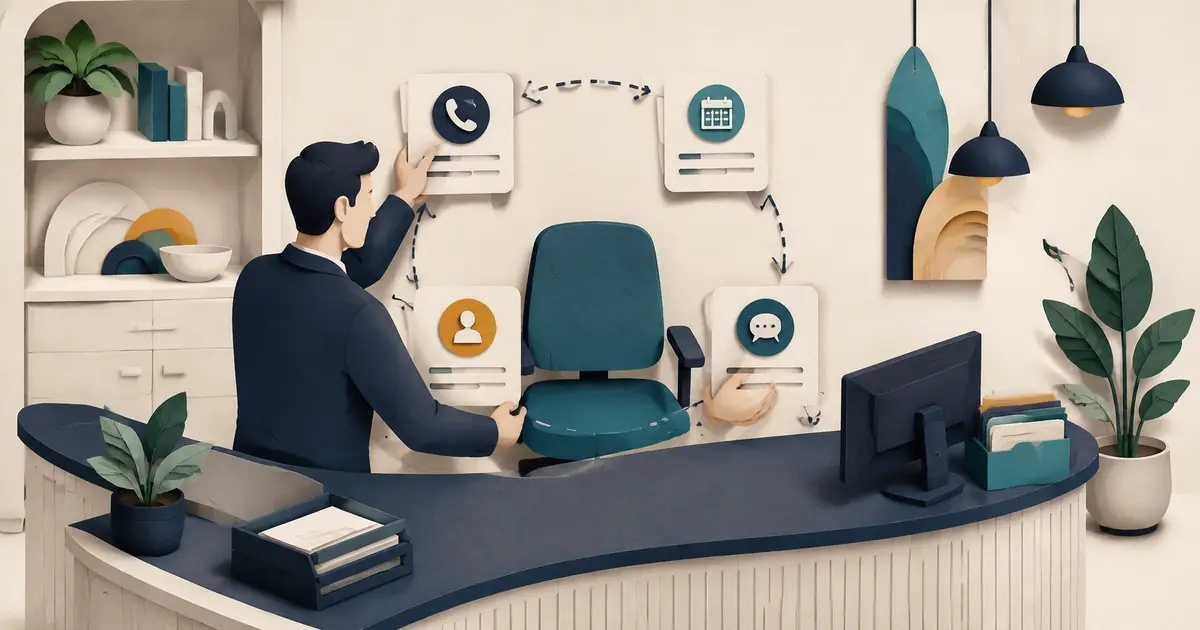
A workable dental receptionist sick-day coverage plan does not try to recreate a fully staffed day. It protects the few functions that cannot wait, gives every incoming request an owner, and deliberately postpones lower-priority work.
The manager's first decision is not “Who can do everything?” It is “What must remain reliable today?” In most offices, that means patient arrival, live phone coverage, same-day schedule changes, clinically directed handoffs, payment and privacy controls, and a visible callback queue.
Use a 15-minute opening response
Start the plan as soon as the absence is confirmed. A short opening huddle is more useful than a stream of individual messages throughout the morning.
| Time | Manager action | Evidence before moving on |
|---|---|---|
| First 5 minutes | Confirm who is absent and which shift is uncovered | Schedule and team roster agree |
| Minutes 5–10 | Name one primary phone owner, one lobby owner, and one backup | Each person repeats their role |
| Minutes 10–15 | Review overnight messages, today's appointments, and known exceptions | Every time-sensitive item has a name beside it |
Do not assign “front desk” as the owner. That label becomes invisible when several people assume someone else is watching it. Use a person's name or a clearly staffed role for each block of time.
The broader front desk workflow ownership guide can help define these roles before the next absence.
Separate must-do work from deferrable work
A sick-day plan succeeds by reducing concurrent work. Sort tasks into three bands.
Protect now
- patients arriving or checking out;
- calls affecting today's schedule;
- messages that the practice's written protocol sends for clinical review;
- callers waiting on a response the office already promised;
- access, payment, or records requests that require an authorized employee.
Complete in scheduled blocks
- routine callbacks;
- new-patient inquiries that do not affect today's schedule;
- insurance or billing questions that need research;
- referral and records coordination;
- non-urgent portal or email messages.
Move to another day
- filing and cleanup that does not block care;
- optional reporting;
- outbound campaigns;
- process-improvement meetings;
- work without a patient-facing deadline.
Deferring work should be explicit. Put it on a dated list with a future owner instead of allowing it to disappear into personal notes.
Build coverage in time blocks
One employee should not cover the lobby and every phone call for the entire day. Divide the day around predictable pressure.
| Block | Primary coverage | Backup trigger |
|---|---|---|
| Opening and first arrivals | Lobby owner protects check-in; phone owner handles new calls | Backup joins when a line waits or the lobby owner needs uninterrupted help |
| Morning treatment start | Phone owner records requests and assigns callbacks | Manager takes complaint or policy escalations |
| Lunch | Written lunch coverage or approved no-answer path | Missed requests enter one callback queue |
| Afternoon peak | Rotate phone ownership to a trained employee | Reassign items that approach the office's callback limit |
| Last hour | Clear same-day items and prepare handoffs | Manager accepts every unresolved item by name |
If the office uses call forwarding or answering coverage, test the actual trigger and caller-ID behavior. A setting that worked during the last holiday may not match today's ring sequence or voicemail configuration.
Give temporary helpers narrow authority
A dental assistant, hygienist, or manager may help answer a phone without taking over every receptionist decision. Provide a one-page boundary sheet:
- office facts they may give without approval;
- requests they may record but not complete;
- who may change the schedule;
- who handles fee, refund, and insurance questions;
- which concerns follow the practice's clinical escalation process;
- what to say when the answer is unknown.
A useful stop phrase is: “I want to make sure the right team member reviews that. I’ll record your question and the best callback number.” It preserves the request without improvising an answer.
The dental office call-handling playbook provides a fuller model for routine and exception calls.
Protect privacy during improvised coverage
Coverage pressure is not a reason to share logins, leave patient details on an open desk, or copy sensitive information into informal group messages. Give temporary helpers only the access needed for their assigned task. Use unique accounts where available, confirm the recipient before disclosing information, and keep the detailed request in the office's approved system.
The HHS minimum-necessary guidance supports developing reasonable policies for applicable uses and disclosures, with important exceptions and context. It does not replace the practice's own analysis of treatment communications, patient access rights, state law, or employment responsibilities.
Schedule callback blocks instead of constant interruption
When every missed call interrupts the temporary phone owner, the queue becomes harder to clear. Set two or three review points and publish them to the team. For example: after the opening rush, after lunch, and 60 minutes before close.
Each callback record should show:
- caller and confirmed callback number;
- original call time;
- neutral reason for the request;
- priority under office policy;
- assigned employee;
- attempt time and result;
- next action or closure.
Use the office's own callback-time standard rather than promising “as soon as possible” to every caller.
Close the day with a five-minute reconciliation
Before anyone leaves, the manager should compare the call log, voicemail or answering queue, front-desk notes, and unresolved tasks. Ask four questions:
- Does every captured request have an owner?
- Was any caller promised an action that did not happen?
- Did any request land in two places or in no queue?
- What must the returning receptionist know before beginning normal work?
Record problems as process findings, not automatic employee failures. An unmonitored inbox or unclear backup trigger needs a system correction.
Where Missed Calls Dental can help
When an eligible call is forwarded to the assigned AI assistant number, Missed Calls Dental can capture the caller's request and place a transcript and summary in Workspace for staff review. That can preserve a request while the reduced team handles patients in front of them.
It does not replace the absent receptionist, change the schedule, make clinical decisions, verify benefits, or complete the callback. Staff still own the next action. SMS follow-up is separate and available only when its registration and readiness requirements are satisfied.
Rachel Morgan is an editorial pen name. This article was reviewed for accuracy and alignment with Missed Calls Dental product information.