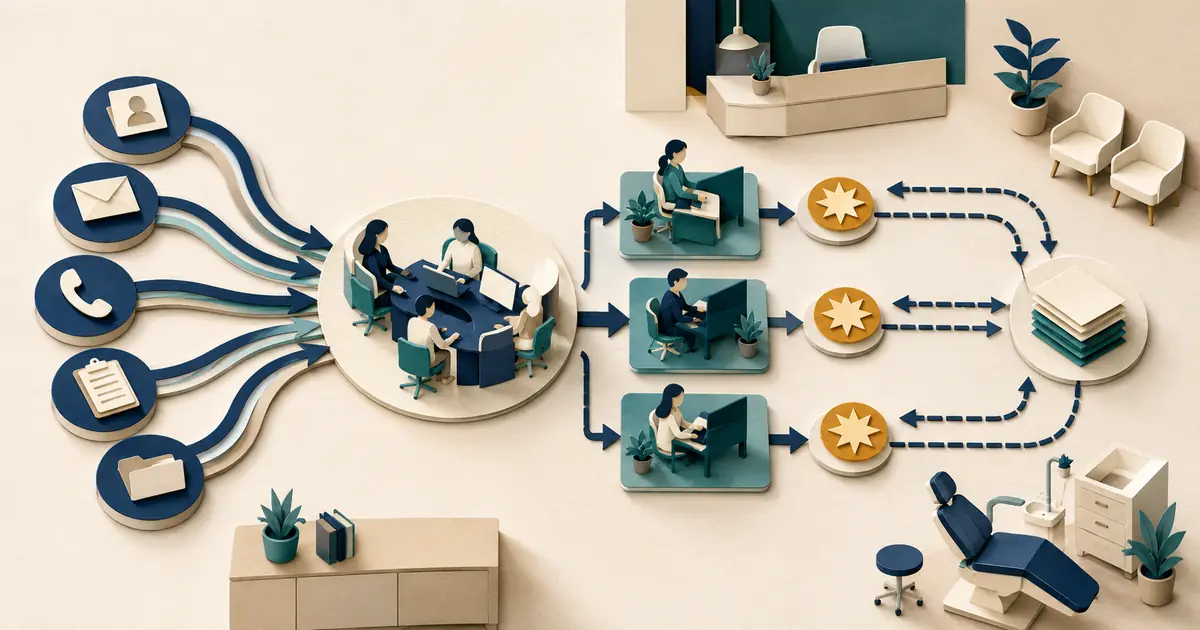
Dental front desk productivity should be measured by reliable patient and office outcomes, not by how continuously busy employees appear. A capacity audit looks for demand, interruptions, unclear ownership, and rework that prevent staff from completing the work already assigned to them.
Run the audit for one representative week. Tell employees the goal is process design, not hidden surveillance.
List the work before timing it
Group front desk demand into categories:
- arriving-patient support;
- checkout and payment workflow;
- live calls;
- missed-call review and callbacks;
- scheduling requests;
- insurance and billing research;
- records and referrals;
- messages for clinical staff;
- portal, email, and text work;
- administrative cleanup.
The list should reflect the actual office. Do not force every task into “phones” or “patients.”
Observe demand in 30-minute blocks
For each block, record:
- employees scheduled;
- patients arriving and leaving;
- inbound calls;
- captured requests;
- callbacks due;
- queue at the start and end;
- unusual events;
- work deferred.
Use counts and short notes. Do not record unnecessary patient information in the audit.
The front desk workflow guide can help define the normal owner for each category.
Measure interruption and rework
An interruption is not automatically waste; helping an arriving patient may be the right priority. The audit should reveal the cost of switching and ambiguity.
Track examples:
- callback restarted because a lobby interruption occurred;
- two employees researching the same request;
- caller repeats information after an incomplete handoff;
- schedule change corrected after being entered incorrectly;
- message sent to the wrong role;
- employee searches for an office fact that should be approved and visible;
- unresolved work copied into personal notes.
Calculate:
Rework rate = tasks repeated or corrected ÷ completed tasks reviewed
Use the rate to identify systems and handoffs, not to rank employees without context.
Find the true bottleneck
| Symptom | Possible bottleneck | Evidence to collect |
|---|---|---|
| Many missed calls during check-in | Same employee owns lobby and phones | Arrival and call volume by time block |
| Callbacks remain open | No protected callback block or unclear owner | Queue age and assignment history |
| Insurance questions interrupt everyone | No defined research queue | Transfers and repeated touches |
| Manager handles routine questions | Approved office facts are hard to find | Question categories and lookup time |
| Work surges after lunch | Lunch route captures requests without an opening owner | Midday queue and first-review time |
Do not solve every symptom by hiring or automation. Some need clearer authority, fewer channels, or a different time block.
Create protected work blocks
Choose work that benefits from uninterrupted time, such as insurance research, referral coordination, or callback reconciliation. Assign a block, a primary employee, and a backup for live interruptions.
Publish what can interrupt the block. Same-day patient needs may qualify; routine reporting may not.
The call-handling playbook shows how live-call ownership can coexist with protected work.
Review service levels
Each queue needs an office-owned expectation:
- when new items are reviewed;
- who owns them;
- what requires same-day action;
- when a backup takes over;
- what “complete” means;
- how unresolved work is handed off.
Use the practice's callback-time standard rather than an arbitrary universal target.
Test one change at a time
Useful pilots may include:
- separate lobby and phone ownership during the opening rush;
- two scheduled callback blocks;
- one shared queue instead of personal notes;
- approved office-information sheet;
- manager-only escalation for defined exceptions;
- no-answer coverage for one measured condition.
Compare the same measures before and after. Note patient volume, staffing, holidays, and system changes so the comparison remains honest.
Keep performance review separate
The audit may reveal training needs, but raw call counts do not show difficulty, privacy requirements, patient needs, or assignment mix. Review employees against clear responsibilities and observed quality. Do not reward speed that creates incorrect schedules, incomplete requests, or poor handoffs.
Where Missed Calls Dental may reduce interruption
For eligible calls routed to the assigned AI assistant number, Missed Calls Dental can capture a request for staff to review in Workspace. That may protect a request while employees assist patients in front of them. It does not perform the staff-owned callback, schedule action, clinical review, or insurance work.
Natalie Chen is an editorial pen name. This article was reviewed for accuracy and alignment with Missed Calls Dental product information.